77 Lubricants, Gulf: OEM oils from the Netherlands
In this section: 2 articles
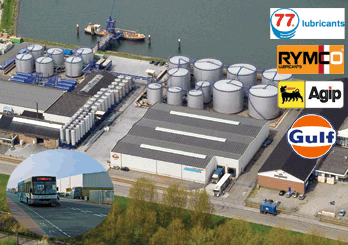 No, these brands (and a few others) aren't united by common owners or corporate groups at all — what unites them is technology, quality and a shared birthplace. That's the oil-blending plant of Transnational Blenders B.V. in the Netherlands, specifically in the city of Dordrecht, right next door to Rotterdam.
Transnational Blenders B.V. is one of the most technologically advanced plants in Europe. Over the past few decades its owners have poured more than €30 million into modernising the facility, and as a result the lubricants made there today sell briskly and enjoy solid demand, not just across the EU but well beyond it.
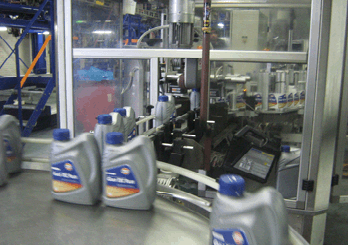 On the CIS markets, the plant's output is sold under the 77 Lubricants, Gulf and Rymco brands, and according to some sources AGIP oils also have Dutch roots (in that case, Transnational Blenders B.V. is one of the producers manufacturing under that trademark).
It has to be said that the Transnational Blenders B.V. plant is a textbook example of a quality OEM lubricant manufacturer, and it has its own line of base products (for more on this, see — what are OEM oils?). The plant sources its base oils from the world-famous Shell, Petronas and Kuwait Petroleum Corporation, and its additive packages from the American corporation Lubrizol (fully bought out by Warren Buffett's Berkshire Hathaway in 2011) and the British chemicals company Infineum (Oxfordshire, United Kingdom).
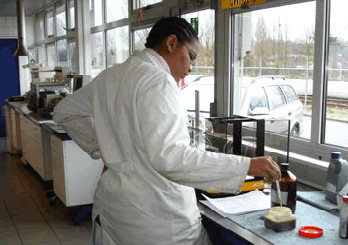
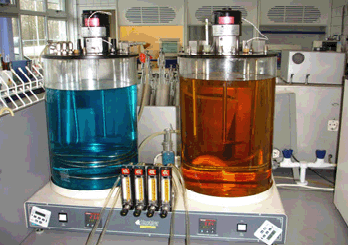 The quality of the finished product is checked by the plant's own modern laboratory, and confirmed by the fact that many engine oils of various brands made at the plant, along with the plant's own products, appear on the official approval lists of leading car makers such as Daimler (Mercedes-Benz), BMW, VAG (Volkswagen-Audi Group), and others.
Is 77 Lubricants the "house" brand of Transnational Blenders B.V.?
Among all the trademarks under which Transnational Blenders B.V.'s output is sold, 77 Lubricants deserves special attention. It's not hard to notice that the 77 Lubricants oil lineup mirrors Transnational Blenders B.V.'s own product range (as shown on the official websites). According to available information, this brand, created in 2008, has ties to the plant that run a bit deeper than a mere commercial arrangement — they share the same owners.
What does this mean for the consumer?
 It's worth understanding that any brand that buys its oil for its own cans from Transnational Blenders B.V. is merely a buyer of a finished product, not its developer or actual manufacturer. And many of the brands listed above have, over their history, changed where their oils are made (as well as the product lines that end up in their cans) more than once. So predicting what quality will be poured into their cans a year, two, or five years from now is practically impossible.
The situation with 77 Lubricants looks somewhat more stable — the brand was built around the plant's own oil lineup, shares owners with the plant, and so the odds of it switching to another manufacturer are minimal. In other words, the chances that the oil in a 77 Lubricants can will still match today's quality a year from now are fairly high, given these objective circumstances, despite the brand's youth.