Step one: finding out the manufacturer's recommendations
In this section: 10 articles
- Choosing engine oil in 7 steps
- In place of a foreword
- How does it usually start?
- Step one: finding out the manufacturer's recommendations
- Step two: so what was in there before?
- Step three: analysing the current situation
- Step four: analysing the market
- Step five: choosing the grade and viscosity of the oil
- Step six: making the choice of oil
- Step seven: buying the oil
And in fact, the place to start choosing an oil is a careful read of your car's service book. That's where you'll find what oil its manufacturer recommends putting in the engine. If your car came to you without a service book, you'll find the information you need from the brand's official representatives or from official parts suppliers for your specific make of car. Don't worry — I'm not going to try to convince you that you need to buy "official" oil — what we need isn't a brand or a manufacturer, what we need are the parameters (specifications, oil approvals).
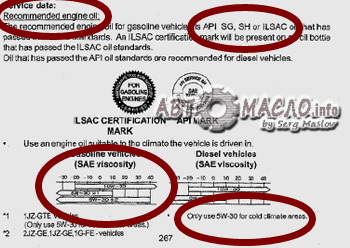 Keep this in mind — approvals are developed for an engine (or a narrow line-up of them), not for the car brand as a whole. A single automaker can have (and does have) several approvals for its various engines, and this absolutely has to be taken into account when choosing an oil. For more detail, see the article on automaker approvals for engine oil.
What will you end up with? It all depends on the make of the car. In most cases you'll get a code (a set of letters and numbers) — the automaker's oil approval for your engine (for Mercedes, for instance, that will be something like "MB 228.3 ", for Audi something like "VW 501.01 ").
Some manufacturers are a bit more modest in what they ask for and will only give you, as a recommendation, the engine oil's designation under the international SAE, API and ILSAC classifications, for example "SAE 5W-40 SL", or the European ACEA quality standard, for example "E6-2005". For more detail, see the article on engine oil classifications. All of this really matters, so try to remember (or better yet, write down) everything you manage to find out about the oil approval from the engine's manufacturer.
Why does all of this matter so much? The answer lies in the chemical composition of the engine oil and the properties of the additives the manufacturer puts into it. Put briefly: every oil has a different set of additives, and so is designed for different engines and operating conditions. Choosing the wrong oil — that is, the wrong bouquet of additives — will, at minimum, cut engine power and increase fuel consumption. At worst, it will simply bring a major engine overhaul that much closer, no more and no less. For more detail, see the article on how additives in engine oil affect engine operation.