A Guide to Drive Belts
In this section: 21 articles
- Movers at the best prices: only from the Dominus company!
- Only Prompt Freight Shipping Across Moscow and the Region from “Pervyi Perevozchik”
- Trucks from Germany
- Choosing diesel fuel suppliers in Moscow
- Shell: a leader in the global energy market
- ATVs: for those who love speed
- How much fuel a plane carries
- Buying a KAMAZ made easy with Kontinental-K
- Portable weighbridges: operating features and applications
- Tyres for trucks
- Taxi services in Moscow
- Quality heavy equipment - the key to success
- IVECO Stralis: award-winning trucks
- Choosing parts is a serious business!
- A Guide to Drive Belts
- By summer, petrol in Russia will rise 10% in price
- Drilling rigs, vans and semi-trailers
- Japanese bulldozers and tanker trucks
- Freight transport services across Russia
- Where to order freight shipping in Saint Petersburg?
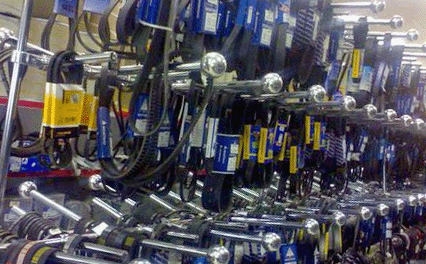 Let us tell you about drive belts. They fall into several groups: V-belts, reinforced toothed belts, multi-groove belts, drive belts for snowmobiles and farm machinery; variator belts, poly-V drive belts, round belts, flat drive belts, and belts for pumpjacks.
Drive belts are also made from specially selected components. Belt-making technology keeps changing and improving. What makes a belt reliable and well made? Here are a few ingredients of their popularity and success: carefully chosen materials, a huge range of belts produced, and the ability to keep refining the technology and running research. The main advantages of drive belts, of course, are service life and reliability.
It's also worth mentioning an important product — high-pressure hoses. They are very widespread across many branches of industry. For example, they're used in making technical equipment for the mining industry, in the paper and pulp industry, and in metallurgy. High-pressure hoses get particular attention in road-building machinery, special equipment, and quarry and mining machines. They're also used in logging and farm machinery.
Flexible hoses are made for hydraulic work (a rubber hose in a braided sleeve). There are also hoses designed for high-pressure and pulsed operations (spiral, rubber hoses). High-pressure hoses aren't fazed by sharp fluctuations and stay flexible (thermoplastic high-pressure hoses). And if you need to transport and load acids or any hazardous, corrosive substances, you'll need polytetrafluoroethylene (PTFE).
Overall, high-pressure hoses are made mostly for hydraulic work and extreme temperatures. There's a secondary use too — spraying various chemicals.
What should you know about conveyor belts? That it's a universal component used in practically every branch of industry. Here are a few of them: food, woodworking, tobacco. They're also used partly in printing and at airports. There are also general-purpose belts. For years now, experts in this field have maintained that conveyor and transport belts are practically irreplaceable.
Source: promobelt.com