What's written on an engine oil label?
In this section: 6 articles
Let's start by decoding the information printed on the packaging of any engine oil, since the vast majority of drivers choose their engine oil based on exactly this information.
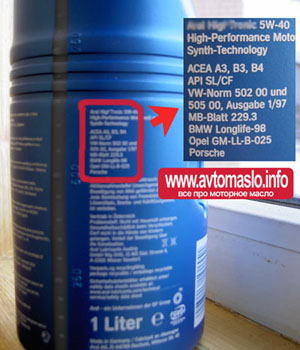 So, what do manufacturers usually write on oil labels? As a rule, there's quite a lot of text about quality, uniqueness and other advantages of this particular manufacturer, and of this particular brand of engine oil.
It's not hard to guess that this is all advertising, whose main purpose is to win over one more customer, so we won't pay any attention to lines like “our oil is the best of the best,” “this oil is perfect for…” and the like.
Just keep in mind that these texts are written by people who have spent years studying the behaviour and motivation of engine oil buyers, and they're not writing about the oil in the can, but about what you want to read there! Don't smile — they really do know a thing or two about it.
The genuinely important information, the kind that actually can and should influence your decision to choose this particular engine oil, is usually printed somewhere inconspicuous, in small print. Why is that? First, because drivers are traditionally considered not particularly savvy about technical details (to put it mildly), and second — that's just tradition, everyone does it that way, and nobody stops to ask why.
So what information is actually useful and important?
The answer is simple — facts, and only facts!
First, a few words about synthetic and mineral oils. In fact, the way the engine oil's base is produced is far from the most important parameter when choosing an oil, even though many drivers pay it special attention. Yes, synthetic oil is better than mineral oil in terms of performance, but will your engine actually feel that difference, given a correctly chosen service interval and an oil that meets your car manufacturer's requirements? Read the article on this and decide for yourself.
Most often, the most prominent spot on the packaging carries information about the engine oil's viscosity under the SAE classification (in the example in the picture, that's 5W-40). In most cases, this is the one parameter of engine oil that drivers easily recognise. Unfortunately, though, the viscosity that car owners look for and buy doesn't always match the viscosity that's actually right for their engines (read more about choosing engine oil viscosity).
But the rest of the information that's genuinely valuable to the buyer is, as a rule, tucked away in a large block of text printed in small type. It's a bit like the ingredients list on food products.
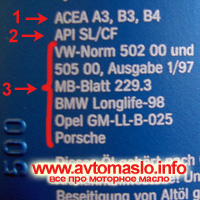 So what are we looking for? We're looking for information about the assigned quality classes and manufacturer approvals, because that's really the main criterion for choosing engine oil. What's more, in the process of obtaining the right to print all these classes and approvals on the packaging, that oil has (in every case) gone through fairly demanding tests and trials, so the presence of all this indirectly confirms, once again, the quality of that particular engine oil.
Today, practically all car manufacturers rely on either the ACEA classification (point 1 in the picture, Europe, read more about the ACEA classification) or API (point 2, USA, more information about API) to define the quality and composition requirements for the engine oil used in their engines, or else they develop their own standards, called approvals (point 3, read more about approvals).
You can also check the country of manufacture on the can, and even match the text against the barcode, but honestly this is hardly a criterion worth much, since brands that respect themselves make sure product quality is consistent across their various plants.
That's essentially all — there's no other useful information on an engine oil label. And now that you know how to decode an engine oil label, you're ready to read the main article on this site: Choosing engine oil in 7 steps.