How not to buy counterfeit oil: the QR code, the seller and the receipt
Or how to check a can without opening it
In this section: 6 articles
The common belief is that two things protect you from a fake: an expensive shop and a careful look at the cap. The can is neat, the label is bright, the hologram shines, so the oil must be genuine. In fact, counterfeiters learnt to make neat cans and bright labels long ago, and the hologram described in the article on protection against counterfeit oils has become just one of several layers of protection. On the other hand, the buyer now has tools that did not exist before, and a few old rules still work.
Counterfeits have not gone anywhere
On 20 March 2025 Ukraine’s Economic Security Bureau announced that it had shut down a large underground operation making engine oils of “well-known world brands” in Kyiv, the Kyiv region and the Dnipropetrovsk region. Officers seized 14,000 litres of finished product, 3,800 litres of raw material and almost 4,000 plastic containers, and the workshops had been bottling more than three tonnes a day. All of it was sold wholesale and retail: online, in shops and at markets. The case was opened under the article on unlawful use of a mark for goods and services (a trade mark, in plain words).
Note two words in that list: “in shops”. In other words, a shop, even a respectable one, is no guarantee against a fake in itself. Sellers do not, as a rule, fake oil themselves, but they buy it wherever it is cheaper and often know no more about where the goods came from than you do.
Nobody knows how many fakes there are on the market. The frightening percentages that wander from one website to another come from the sellers and distributors themselves; there are no state statistics and no independent study behind them. So there is no point being scared by figures — it is enough to know that a fake can turn up anywhere, and to check.
As for what a fake threatens, that hardly needs explaining. A counterfeit can may hold anything, from cheap oil of another class to a mixture of unknown origin, and this liquid has none of the approvals printed on the label, even if someone did pour something decent into it. So you have not met the carmaker’s requirement, the one this whole site rests on, although that is exactly what you paid for.
Where to buy
The main rule has not changed: oil is best bought from first-hand sources (more on this in the article on how and where to buy oil). What has changed is something else: more and more oil is ordered online, on marketplaces and from online parts shops, and there you never see the seller’s face. Hence a few simple habits.
1. Buy from those the manufacturer itself names. Big brands usually list their distributors and partner shops on their official websites. A minute of searching, and the job is half done.
2. Check who exactly is selling. On a marketplace the seller is not the marketplace itself but a particular company or sole trader. A decent seller’s page shows a name, a company registration (EDRPOU) code, or a personal tax number for a sole trader, and an address. Nothing but a nickname and a phone number — keep looking.
3. A price well below the market is not luck but a warning. How can one seller’s genuine oil be noticeably cheaper than everyone else’s? There is usually no honest answer to that question. Genuine “branded” oil at half price turns up about as often as a genuine Swiss watch in a pedestrian underpass.
4. Take the receipt. Always. From an online shop too: paper or electronic, it makes no difference. Without a receipt any claim becomes your word against the seller’s.
What to check on the can
How to read a label in general is explained in detail in the article what is written on an engine oil label. Here we will deal only with what matters for counterfeits.
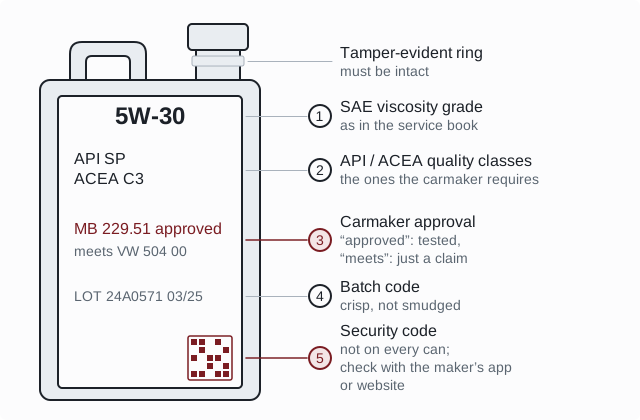
Security codes
Some cans of some brands now carry something that did not exist before: a unique security code you can check with your phone. Each manufacturer has its own system. Mobil, for example, prints a secure 2D code on the label in a number of markets: you scan it with the Scantrust app, and the app tells you whether the product is genuine. Shell in certain markets (Malaysia, for instance) uses a peel-off label with a unique QR code. Castrol uses laser-printed batch marking, and in some markets it has scannable codes as well.
A few points are very important to understand here.
Which protection your particular can carries depends on the brand and on the batch. What a given brand uses in Ukraine you will learn from its official website, not from the seller.
A QR code by itself is just a link. A counterfeiter can print a QR code leading to a nice little “Original confirmed” page just as easily as a label. So check the code with the app or on the website the manufacturer itself names, and look at where exactly it has taken you.
No code does not prove a fake, and a code does not prove the original, until you have checked it. An ordinary barcode is no help at all here: it is the same on every can of that oil, and copying it costs nothing.
Approvals and the small print
The second thing worth reading carefully is the line with the approvals. The word “approved” (or “Freigabe”) next to an approval code means that the carmaker has tested this oil and entered it in its list, whereas “meets”, “suitable for” or “complies with” is only a claim by the oil manufacturer (more on the difference in the article what oil approvals are).
For the buyer this matters in two ways. First, a genuine approval can be checked away from the can: carmakers keep lists of approved oils, and Mercedes-Benz, for example, keeps its list open to everyone. If the label promises “approved” but the oil is not on the list, have your doubts about either the oil or the seller. Second, if your engine needs a proper approval, “complies with” is no substitute for it. How approvals have changed over the years is covered in the article on the carmakers’ new approvals.
One more small thing that is easy to check: Ukrainian law requires product information to be in Ukrainian, with the name and address of the manufacturer and of whoever accepts claims (usually the importer), even if only on a sticker. A can without a single word of Ukrainian and without an importer is at the very least a reason to ask the seller where it came from.
If in doubt
Nobody has cancelled the old checks: the tamper-evident ring on the cap must be intact, the label stuck on straight, the batch code printed crisply, not smudged. The colour of the oil, on the other hand, tells you nothing about either quality or origin, so there is no point opening the can “to have a look”.
If something has put you on your guard, do not pour this oil into the engine. Another can (or, if you have already filled up with it, an extra oil change with all its costs) is far cheaper than an engine after an unknown liquid.
1. Keep the can and the receipt. Throw nothing away, including your correspondence with the online shop.
2. Contact the brand’s official representative. As a rule, they can compare the batch code and the label with what the brand actually produced.
3. Make a claim against the seller. Ukraine’s consumer protection law expressly names falsification of goods as grounds for demanding a refund or a replacement from the seller; if necessary, this is established by an expert examination. A consumer’s demands are considered on presentation of the receipt — that is what you needed it for.
4. If the seller refuses, complain. Consumer protection is the job of the State Service of Ukraine on Food Safety and Consumer Protection (Derzhprodspozhyvsluzhba). And if you suspect you have stumbled on an underground bottling operation, that is a matter for the Economic Security Bureau, which is exactly the body that shuts such places down.
So the most reliable protection against a fake is a seller the manufacturer itself names, a receipt and a minute to check the code wherever there is one. Holograms and QR codes help, but they do not replace the main thing: knowing who you are buying from.
Further reading: is there a difference between Mobil oils from different plants?