How to choose parts
In this section: 8 articles
- How to choose shock absorbers for a car
- How to extend the life of an automatic transmission?
- How to choose parts
- How to get your car ready for vacation?
- In Brief: About Bulb Wattage
- Working shock absorbers extend the life of the suspension
- Don't forget to get the suspension checked!
- How to extend the life of an automatic transmission? The handbrake rule
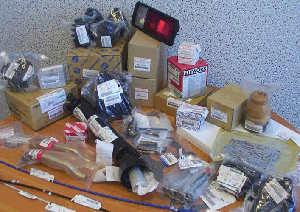 Have you ever wondered how and out of what wooden houses are built? Don't smile, it's a serious question. Because what really matters for the reliability and the "life span" of a wooden house is the material it's built from. And the question isn't even about the wood itself – it's about how it's prepared and treated. It's much the same story with car parts – how long they last, and your safety, depend directly on the materials the parts are made from.
So, during a routine visit to the garage, the latest inspection of your car's running gear ends with a verdict listing N items that need replacing in the near future. You go to the shop and find out that for every item on the list you can be offered 4-5 options, and the price of the cheapest one can turn out to be 5-10 times lower than the most expensive. What do you choose?
Well, seeing as you've gone to a parts shop in the first place, let's risk assuming that the pricing policy of your car brand's official dealer doesn't suit you. By the way, genuine parts don't always turn out to be the most expensive in practice, and it's actually quite common for genuine parts to cost only 10-20% more than replacements of dubious quality.
So, step one: to start with, go to an official service centre anyway and find out all the prices for the genuine parts you need – this will serve as a benchmark for your further search.
Step two: study the parts market for your specific car. Don't be lazy – write down absolutely every manufacturer whose products are offered to you as replacements, along with prices, and ideally visit several large parts shops. Compare the prices against the genuine part right away – if a replacement turns out to be more expensive than the original, cross it off the list without hesitation. As a rule, nothing beats the genuine part, whatever the salesperson tells you.
Step three: find the most visited forum for your car's make on the internet (there are plenty of car clubs these days, you can find one for pretty much any car) and, using the names of the manufacturers (and possibly even specific part numbers), look up reviews and any negative fitting experiences. It's possible that by this stage your list will already be down to just one or two decent replacements. It's worth stressing – look specifically for the negatives, but filter the information as you go: as a rule, the wording of a forum post, together with how credible its author is (registration date, number of posts, reputation, and other details visible to readers), tells you right away how much that post deserves your trust.
Step four: if your car isn't Chinese-made, feel free to cross off every part of Chinese manufacture from your list – unfortunately, Chinese manufacturers still haven't learned to make quality materials for parts, so they tend not to last long. With the same resolve and for the same reason, cross off every replacement made in Turkey and Italy too (even if you found positive reviews about them).
Step five: for everything left on your list, compare the price against the genuine part: if the difference is 20-25%, it's worth trying to find the same genuine part for less – either from a trusted seller or online (practically every regional car club forum has parts sellers hanging around, offering good prices on genuine parts).
Step six: make your final choice and buy the parts – either genuine or good-quality replacements. And don't forget that your car's running gear is your life, and the lives of your passengers too, so unwise savings have absolutely no place when it comes to choosing parts.
Finally, one more parallel: remember that precision in parts manufacturing matters just as much as the precision of dimensions and tolerances built into wooden house designs – in both cases, any deviation in dimensions can wreck an entire assembly or unit, which down the line leads to significantly higher extra costs.
Have a safe trip!