How to get your car ready for vacation?
In this section: 8 articles
- How to choose shock absorbers for a car
- How to extend the life of an automatic transmission?
- How to choose parts
- How to get your car ready for vacation?
- In Brief: About Bulb Wattage
- Working shock absorbers extend the life of the suspension
- Don't forget to get the suspension checked!
- How to extend the life of an automatic transmission? The handbrake rule
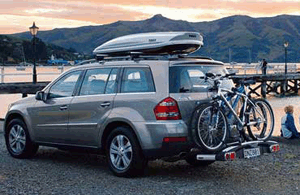 Vacation season is coming, and you're heading off on a road trip in your own car. Besides packing your things and trying not to forget anything, you also need to take care of the car itself, because you still have to actually get to your destination. Even a minor breakdown on the road is guaranteed to cost travellers a lot of completely unnecessary hassle and expense.
It's worth saying right away that none of the advice below loses relevance regardless of the car's make — whether it's a brand-new Hyundai Tucson, a Mitsubishi, or a battle-worn BMW.
So how exactly should you prepare a car for a long trip? The easiest way, probably, is to work from a list. There's an analogy with the supermarket here — with a shopping list written by your wife, it's practically impossible to forget anything. So let's try to put together a simple checklist of things that need doing in the near future.
- Check that the car has the necessary items and tools on board: a screwdriver, a wheel wrench, a locking wheel-nut key, a jack, a first-aid kit, a fire extinguisher, and a tow rope. We'd also recommend taking a set of wrenches, jumper cables, a flashlight, a spare battery for your alarm fob, a set of spare bulbs for the indicators, headlights and brake lights, and a compressor. Remember, an extra car part never hurts on the road.
- Check the running gear. Yes, this is a truism, but believe it or not, not every car owner remembers it. Here's a tip: schedule your visit to the garage in advance, since on the last day before departure there may be a queue.
- Check that all fluids and oils are present and at the right level: rear axle lubricant (if fitted), gearbox oil, power steering fluid, coolant, and brake fluid. If there's a leak anywhere, it absolutely must be fixed before you leave, or you risk spending the night stranded in a field, along with some serious unplanned expenses. On top of that, in many European countries you can be fined for it.
- If your car has climate control, replace the cabin air filter.
- Be sure to change the engine oil! If there are only one or two thousand kilometres left before the scheduled service, it's better to do it before you set off. On the trip the engine will probably be working in an unfamiliar way, so it's far better for it to have fresh oil. Even if there's no oil consumption to speak of, I'd still recommend keeping at least a litre of oil in the boot just in case. Don't skimp on buying the oil either: it needs to be genuine and fit for purpose, whether that's Teboil, Total, Mobil 1 or Esso oil.
- Check the condition of the wheels. Carefully inspect the rims and the tyres, both from outside and inside (including the spare wheel). Everything should be even and round. There should be no bulges on the tyres, no delamination, no nicks on the rims, and no other flaws that you might get away with for a while in city driving — none of that is acceptable here. Be sure to check the tyre pressure — the car will likely be more heavily loaded than usual, so it makes sense to inflate the tyres a bit harder than you normally would.
Have a good trip!