Oil for car engines
In this section: 32 articles
- How to correctly choose automotive oil?
- Which car oil is better?
- What Criteria Should You Use to Choose
- What to take into account when choosing engine oil?
- What Criteria Should You Use to Choose Automotive Oil?
- What to take into account when choosing oil?
- What Parameters Should You Use to Choose an Engine Oil?
- What Criteria Should You Use to Choose Engine Oil?
- Choosing the right oil
- How to correctly choose engine oil?
- Choosing oil: the manufacturer's approval
- Which oil is better?
- Which car engine oil is better?
- What to take into account when choosing car oil?
- In Brief: Does Oil Add Horsepower?
- In Brief: More Expensive Doesn't Mean Better...
- Choosing oil: by parameters and approvals
- How to choose the right automotive oil?
- How to correctly choose automotive oil?
- How to choose the right automotive oil?
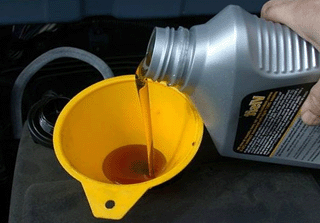 The performance of your car's engine, its durability, power and fuel economy, all depend directly on the engine oil. That's why, whatever the make — a Lada or a Lexus — an oil change is simply essential, and it needs to be done on a regular basis, without putting it off for too long.
Why does an engine need oil at all? Its main job is to cut down friction, and on top of that it keeps the engine sealed and helps carry away heat. Engine oil is made up of a base, or "base stock" as it's also called, plus a certain amount of additives that give the oil the properties it needs. Based on how the base is produced, oils are split into mineral oils, obtained by refining crude oil, synthetic oils, produced chemically, and semi-synthetic oils, which, as the name suggests, are a blend of synthetic and mineral oils. There are also so-called hydrocracked oils, which in their properties sit close to semi-synthetics.
Besides how they're produced, synthetic and mineral oils differ in their properties too. For instance, in its core qualities, mineral oil falls short of synthetic oil, though it's considerably cheaper. Synthetic oil holds up better against high temperatures and resists oxidation excellently. Synthetic oils also have the highest viscosity index.
As for the additives that go into oil, there's a huge number of them, and each changes the oil's properties and characteristics in its own way. Some additives boost viscosity, others protect the engine from corrosion. There are detergent additives, anti-foaming additives, and plenty more. Oil is classified under international standards by viscosity (SAE) and by performance level (API or ACEA standards).
You should choose the oil the carmaker recommends, or the closest match to it. Following these recommendations will keep the engine running long and trouble-free. Sometimes the owner's manual recommends a specific oil brand, and if your car is still under warranty, it's best to use exactly that oil. And while the car is still under warranty, it's best to have the oil changed at a service centre too. As for something like stripping down a Lexus, an engine rebuild, or a wheel alignment, there's no need to even discuss it — those should be handled by professionals.
Once the warranty period ends, you can switch to a different brand of oil with the closest matching specifications. On top of that, you need to factor in the specific engine, its operating conditions, and its degree of wear. When buying oil, watch out for counterfeits. The label should show the production date, the manufacturer's address, and certification information. The cap should be sealed, the label glued on evenly, and the oil itself should be clear and free of any sediment. It's better to buy from a specialised shop rather than a market stall.