“Synthetic” on the label: what is really in the can?
Or can you trust the word “synthetic” on a can?
In this section: 7 articles
So, there are three cans of the same viscosity on the shelf. The first says “100% synthetic” in big letters, the second, more modestly, “synthetic technology”, and the third, a German one, carries some puzzling “HC-Synthese”. The shop assistant, naturally, recommends the first — that one is the “real thing”. Sound familiar?
In fact, the word “synthetic” on a label has long since stopped meaning almost anything. We have already looked at what hydrocracking is in a separate article: put simply, it is deep chemical processing of a petroleum base oil, after which its properties come close to those of a synthetic one. But how hydrocracked oil became “synthetic”, and what the buyer should know about it, is what we will try to sort out here.
Five groups of base oils
First, a little order in the terms. In its engine oil licensing system the American Petroleum Institute (API) divides all base oils into five groups. It divides them not by the words on the label but by measurable properties: the saturates content, the sulphur content and the viscosity index (the higher it is, the less the oil thins out when it heats up).
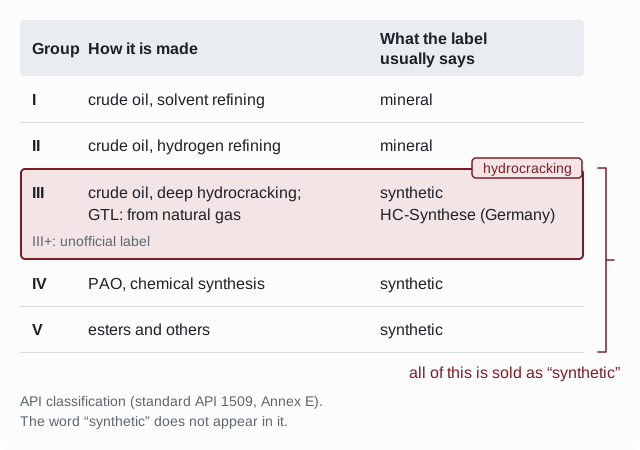
Group I. The classic mineral base oil, cleaned of unwanted impurities with solvents, the old way. It has less than 90% saturates or more than 0.03% sulphur, and a viscosity index of 80 to 120.
Group II. The same crude oil, but refined with hydrogen (hydrotreating, often with mild hydrocracking as well). At least 90% saturates, no more than 0.03% sulphur, and the same viscosity index of 80 to 120. On the label this is, as a rule, still a “mineral” oil.
Group III. The same petroleum feedstock after deep hydrocracking under harsher conditions: the sulphur and saturates limits are those of Group II, but the viscosity index is at least 120. This is exactly what hydrocracked oil is, the very oil that the can most often calls “synthetic”.
Group IV. PAO (polyalphaolefins) — synthetic in the literal sense of the word: this base oil is not separated from crude oil but synthesised at a chemical plant.
Group V. Everything that did not fit into the first four groups, above all esters.
Note: the word “synthetic” does not appear in this classification at all. There are groups, and what to call the oil on the can is decided by the marketing department.
How hydrocracking became “synthetic”
Back in the late 1990s, “synthetic” in engine oil advertising, as a rule, meant oils based on PAO. Then Castrol switched its synthetic oil for the American market to a Group III hydrocracked base oil and kept the word “synthetic” on the can. Mobil complained. The complaint was heard not by a court but by the National Advertising Division (NAD) of the American Better Business Bureaus, an advertising self-regulation body. In April 1999 it accepted Castrol’s evidence: an oil based on Group III could be advertised as synthetic. Mobil chose not to appeal.
What happened next is not hard to guess. Hydrocracking is far cheaper than synthesis, and the word “synthetic” sells better, so most of the big manufacturers moved their “synthetic” oils to Group III. Rather like “homemade” sausages in a supermarket: nobody actually promised they were made in anyone’s home. That is why telling hydrocracked oil from synthetic oil by the label is, as a rule, impossible (more on this in the article on how to tell hydrocracked oil apart).
The German exception: HC-Synthese
Not everyone agreed with this. In Germany one manufacturer took a competitor to court for advertising an oil on a hydrocracked base as a “fully synthetic engine oil of a new generation” (vollsynthetisch). The Regional Court of Cologne dismissed the claim in 2015, the court of appeal in Cologne banned the wording, and on 21 June 2018 the Federal Court of Justice of Germany (BGH, case I ZR 157/16) upheld the ban.
The court’s reasoning is simple and, to my mind, sound: a buyer who sees the words “fully synthetic” expects a separate, more expensive category — Group IV or V base oils, that is, PAO or esters. And if the can holds hydrocracked oil, that buyer is being misled.
The court did not invent any new terms. But German labels are more honest today: Group III oils there are usually marked “HC-Synthese” (HC from the English hydrocracking). So these letters on a German can mean an honestly named hydrocracked oil, not something worse.
What you need to understand is something else: this is a German rule. Neither the EU as a whole nor Ukraine has a legal definition of “synthetic” for engine oil. So on the Ukrainian market the word “synthetic” on a can may mean PAO, esters or Group III hydrocracked oil alike.
GTL, PAO, esters: what is used where today
Meanwhile, hydrocracking itself has not stood still.
First, base oils that the industry unofficially calls III+ have spread: hydrocracked oils with an especially high viscosity index. The API classification has no separate group for them; formally they are the same Group III.
Second, GTL base oils (gas-to-liquids) have appeared, made not from crude oil but from natural gas. The best-known example is Shell’s Pearl GTL plant in Qatar, which has been producing base oil since 2011. The feedstock is different, but under the API classification this is Group III too.
As a result, Groups III and III+ now form the base of most oils labelled “synthetic”, and they have pushed PAO out of many “fully synthetic” formulations.
PAO and esters have not gone anywhere, though. They are still used, mostly in expensive and sports oils, and in 0W oils, where low volatility and flow in the cold matter most. The catch is that you will rarely find this on the label: the make-up of the base oil is the manufacturer’s trade secret, and it may print “synthetic” on any of them.
What does this mean for the buyer?
Does all this mean that Group III “synthetic” is a fraud and you have been cheated? No. A good-quality Group III oil with the required approvals is not a counterfeit and not a “fake” synthetic, but a normal modern engine oil. A car manufacturer grants its approval on the results of tests on the finished oil, not on the name of its base oil. And if the oil has passed those tests, your engine does not care whether its base came from crude oil, from gas or from a chemical plant.
So in practice it all comes down to a few simple rules.
1. Look at the approvals, quality classes and viscosity your car’s manufacturer requires, not at the word “synthetic”. It is they, not the big letters, that decide whether an oil suits your engine (more on this in the article what are oil approvals). And remember: “meets the requirements” on a can is not an approval yet, only a promise from the oil maker itself.
2. Do not overpay for a word. If a PAO or ester oil has the same approvals as a hydrocracked one but costs noticeably more, whether the difference is worth the money is for you to decide. Both meet your car manufacturer’s requirements.
3. You do not always need synthetic. If an oil with the required approval and viscosity is called semi-synthetic or mineral on the label, it will do your engine no harm (more on this in the article which is better — synthetic or mineral).
4. A counterfeit is something else entirely. A counterfeit is an unknown liquid in a can of a well-known brand, with nothing in common with either the label or the approvals. For how not to buy one, see the article how not to buy counterfeit oil.
Let me say it once more: engine oils are not divided into synthetic, hydrocracked and mineral, but into those that suit your engine and those that do not (see the article can hydrocracked oils be used). The word “synthetic” on the label guarantees nothing — all that matters is the approvals, quality classes and viscosity your car manufacturer requires.