Replacing Honda parts in a car's braking system
In this section: 57 articles
- 3D wheel balancing
- A driving instructor for experienced drivers
- A woman's car
- Choose genuine Peugeot parts from AvtoGlobus!
- What's an online store for?
- Body parts for the Nissan X-Trail T31 in your city
- Reliable reverse cameras and factory-fit head units
- Number plate theft
- Statoil car oils, lubricants and petrol
- Original Parts for Foreign Cars
- Parts for foreign cars: where to buy?
- Types of screw compressors
- How to bleed air from a BMW clutch actuator
- Replacing a damaged BMW driveshaft boot
- Car-wash chemicals: effective products
- Original Japanese Auto Parts: An Alternative to an Engine Swap
- Kia car seat covers
- Dry cleaning your car's interior
- Types of tuning
- Bike-mounting accessories
 A car's safety on the road depends on its owner following the rules of the road, and on every system and mechanism being in sound working order. And while the first depends mainly on a person's character, self-discipline and sense of responsibility, the second is impossible without professionals stepping in. All that's required of the driver here is showing up on time for every scheduled service, and the rest falls to qualified service technicians.
Their job includes assessing the vehicle's overall condition, checking for damage in various assemblies, and identifying potentially vulnerable spots and sources of risk. Based on the picture that emerges, a decision is made on whether preventive or repair work is needed, and on replacing components and consumables. Every system in the car deserves serious attention, but the most attention needs to go to the ones that directly affect the vehicle's safe participation in traffic. The braking system is certainly one of them.
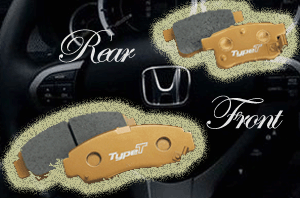
Honda parts related to it are under constant, colossal loads: on starting, stopping, accelerating and slowing down. All of this gradually wears them out. This is especially true of consumables — discs and pads, which need periodic replacement according to the car manufacturer's schedule. Their service life can be measured either in time or in mileage. But it's worth remembering that the recommended intervals, set based on assumed driving conditions, are one thing, while the real conditions, shaped by the state of our roads, fuel quality and traffic jams, are something else entirely.
That's why it's important for every car owner to keep a close eye on the car's condition and go to a service centre at the slightest suspicion of a brake fault. Signs worth watching for include unusual noises, the car pulling to one side, the pedal sinking too far or feeling too stiff, and consumables wearing down to the minimum allowed thickness. Discs and brake pads must always be in good condition and have enough life left to work well as a pair. Damage to one will lead to damage to the other, since they're in constant interaction. To extend the life of each part, it helps to know a few facts — for example, that hard pads wear discs down faster, or that ventilated discs have a much longer service life than solid ones thanks to better heat dissipation under load. A service centre's consultants can provide all this information along with other useful tips, and experienced technicians will handle any diagnostic, repair or maintenance work.