Types of screw compressors
In this section: 57 articles
- 3D wheel balancing
- A driving instructor for experienced drivers
- A woman's car
- Choose genuine Peugeot parts from AvtoGlobus!
- What's an online store for?
- Body parts for the Nissan X-Trail T31 in your city
- Reliable reverse cameras and factory-fit head units
- Number plate theft
- Statoil car oils, lubricants and petrol
- Original Parts for Foreign Cars
- Parts for foreign cars: where to buy?
- Types of screw compressors
- How to bleed air from a BMW clutch actuator
- Replacing a damaged BMW driveshaft boot
- Car-wash chemicals: effective products
- Original Japanese Auto Parts: An Alternative to an Engine Swap
- Kia car seat covers
- Dry cleaning your car's interior
- Types of tuning
- Bike-mounting accessories
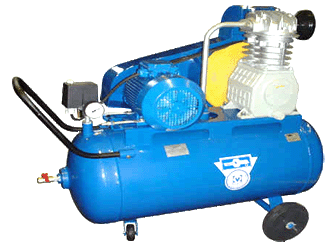 Screw compressors currently remain one of the most widespread types of equipment. Manufacturers keep improving these machines, but a number of advantages have stayed constant. These include high reliability and durability, compactness, low weight, and no need to lay a substantial foundation. On top of that, screw compressors don't produce strong vibration while running.
There are several types of screw compressors in use today. These are oil-flooded machines and dry-running compressors. In refrigeration equipment, oil-flooded screw compressors are the ones most commonly used. Let's look at their features. In machines like these, a large amount of oil is fed into the compression chamber.
Oil-flooded compressors have a number of advantages over dry-running machines. Above all, there's a lower percentage of internal vapour leakage, plus an increase in the compressor's delivery volume. This is possible because the gas being compressed is cooled by the oil, and the oil also seals the clearances between the machine's components. The compressor has a fairly simple design, runs at a low rotation speed, and produces almost no noise. Thanks to the drop in vapour temperature during the machine's discharge stage, we get an extended range of single-stage compression. As for the drawbacks of oil-flooded screw compressors, these come down to an increase in the machine's weight and dimensions compared with dry-running units. A compressor's larger size is needed to build a developed lubrication system for its parts and assemblies.
In dry-running screw compressors, no oil is fed into the working chamber. To reduce air losses, the machine's components are manufactured to a high degree of precision. There's a temperature difference between the inlet and outlet of the chamber, which limits how far the pressure can be raised. To get around this, dry-running screw compressors are built with several stages. There are also dry-running machines with liquid injected into the working chamber. The liquid performs a lubricating and cooling function. Compared with piston compressors, screw compressors are more reliable and durable, simple to operate, and don't need frequent repairs. Unfortunately, the energy efficiency of such machines is somewhat lower than that of piston compressors.