Piston compressors: types and specifications
In this section: 57 articles
- 3D wheel balancing
- A driving instructor for experienced drivers
- A woman's car
- Choose genuine Peugeot parts from AvtoGlobus!
- What's an online store for?
- Body parts for the Nissan X-Trail T31 in your city
- Reliable reverse cameras and factory-fit head units
- Number plate theft
- Statoil car oils, lubricants and petrol
- Original Parts for Foreign Cars
- Parts for foreign cars: where to buy?
- Types of screw compressors
- How to bleed air from a BMW clutch actuator
- Replacing a damaged BMW driveshaft boot
- Car-wash chemicals: effective products
- Original Japanese Auto Parts: An Alternative to an Engine Swap
- Kia car seat covers
- Dry cleaning your car's interior
- Types of tuning
- Bike-mounting accessories
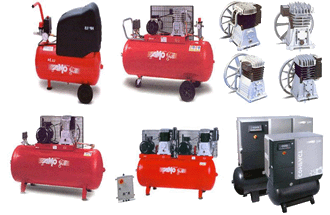 Piston compressor units have been familiar to consumers here for a long time. Today piston compressors are still popular, widely used, and have practically no rivals in terms of the balance between what they can do and what they cost.
These units work quite simply. Atmospheric air passes through the air filter and intake pipe into the compression chamber — the cylinder, where the working volume of the chamber is reduced by the back-and-forth motion of the piston. As a result, the air pressure rises, and compressed air comes out of the discharge pipe ready for further use.
A piston unit suits those situations better than others where compressed air isn't needed constantly, only from time to time.
Multi-stage compression lets a piston unit be considered the most economical way to produce compressed air. Screw-type models, for comparison, are a bit more reliable but significantly more expensive. So piston compressors — used sensibly, of course — are the cheapest units to run.
Piston compressor units come as oil-lubricated or oil-free. Oil-free versions are mainly used in fields that demand a high level of quality, sterility and cleanliness in the compressed air, such as medicine and food production, as well as certain industrial settings (auto service shops, paint booths). The air an oil-free compressor produces is practically ideal — it contains neither oil itself nor oil vapour. And that's not the only advantage of these units. Oil-free models are compact, and moving and installing them doesn't take much time. On top of that, such compressors need almost no maintenance, since they run automatically.
Oil-lubricated units come as domestic or industrial. Domestic oil-lubricated units are built specifically for conditions where simplicity of use, modest weight and size, and low power are what's needed. Such models are widely used, for instance, in various workshops (where compressed air is needed because of the nature of the work).
Industrial oil-lubricated compressor models differ from domestic ones in that they can run for long stretches with practically no break. Domestic piston compressor models, on the other hand, need periodic and fairly long rest.