Body fillers for automotive bodywork repair
In this section: 57 articles
- 3D wheel balancing
- A driving instructor for experienced drivers
- A woman's car
- Choose genuine Peugeot parts from AvtoGlobus!
- What's an online store for?
- Body parts for the Nissan X-Trail T31 in your city
- Reliable reverse cameras and factory-fit head units
- Number plate theft
- Statoil car oils, lubricants and petrol
- Original Parts for Foreign Cars
- Parts for foreign cars: where to buy?
- Types of screw compressors
- How to bleed air from a BMW clutch actuator
- Replacing a damaged BMW driveshaft boot
- Car-wash chemicals: effective products
- Original Japanese Auto Parts: An Alternative to an Engine Swap
- Kia car seat covers
- Dry cleaning your car's interior
- Types of tuning
- Bike-mounting accessories
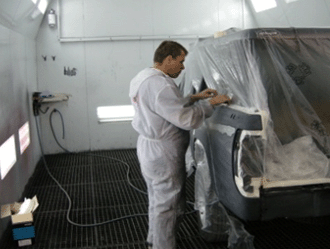 Repairing a car's body is a process made up of several stages, the last of which is painting. Before that can be done, though, the surface needs to be properly prepared first. That's why every serious service station doing bodywork repair in Moscow makes a point of using various high-quality fillers for this purpose. Depending on their scope and specifics of use, they're divided into several types.
One of the most common types of automotive filler is reinforcing filler. Essentially, this is an ordinary coarse-grained filler with fibreglass elements added to it. Auto shops doing bodywork repair in the south-west administrative district and other parts of the capital most often use reinforcing filler in cases where fairly large irregularities need to be removed from the car body's surface. This filler can be applied either directly to bare metal or to the paintwork, which should first be thoroughly sanded down. Reinforcing filler has very high mechanical strength, and it can even be used to repair small areas with through-corrosion.
So-called build-up filler is also fairly widely used. Just like reinforcing filler, it's used in cases where the body's irregularities after repair are quite substantial. A distinctive feature of build-up filler is its coarse-grained structure. Because of that, pores can form in it after it's been applied to metal or paint. To hide these, so-called finishing filler is used, also known as "fine" filler.
Companies doing bodywork repair in the south-west administrative district that come up against the need to restore various plastic parts (bumpers, for example) often use a special filler for plastics. This is a fine-grained compound, distinguished by a high degree of adhesion to plastic. It's fairly expensive, so a thin layer of it is often applied to the plastic part first, with ordinary filler applied over the top.
If a fairly large area needs filling, a special compound is normally used that can be applied by spraying. This filler is typically two-component, and requires a hardener to be added before use.