Sale of confiscated cars by Ukrainian banks
In this section: 36 articles
- Mitsubishi Lancer X - changes and specifications
- Diagnosing a car “by eye” - picking an accident-free car
- Renting a car abroad? Easy as pie!
- Phoenix Motors - a Suzuki dealer in Petersburg
- Ford Focus
- The Ford Explorer - a great car for active, sporty owners
- Attention to detail matters most when choosing a car
- Car Valuation Is a Job for Professionals
- Test drive: the Toyota RAV4
- Automotive news from the Subaru group
- The car and the road: believe in your own abilities!
- What's New in OSAGO for 2010
- Car rental in Turkey
- Where do wrecked cars end up?
- Audi Centre Petersburg: official Audi dealer
- Moscow car pawnshops during the crisis
- How to safely buy a car over the Internet
- Sale of confiscated cars by Ukrainian banks
- Advantages of the express car buy-back service
- Choosing your first car
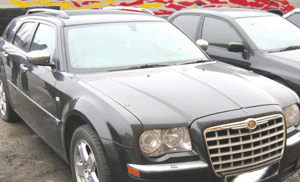 Repossessed cars appear on the sales market as a result of a situation where a person who has taken out a bank loan can no longer, for whatever reason, keep up the payments. Large loans are usually issued against collateral belonging to the borrower. Most often that collateral is a car, and the car then passes into the bank's ownership, its value covering the unpaid loan. The bank, naturally, welcomes a borrower's voluntary decision to hand over their property. In cases where the borrower fights to the last to keep the car, the bank goes to court, and after lengthy proceedings the car still ends up in the bank's ownership.
Banks have no use for repossessed cars — it's far more profitable for them to sell it at the best possible price. To get rid of the repossessed stock as fast as possible, the bank sells it at a reduced price, posting listings on its own website. Repossessed cars are also very often sold at auction. This method of sale is more profitable for the bank, since it allows the repossessed car to be sold for more. By law, the price of a collateral vehicle must be set with the involvement of a court enforcement officer and an independent appraiser.
Selling repossessed cars is generally handled by trading organisations that have been granted the right to run car auctions. To take part in such an auction, you need to follow all its rules to the letter. Participant registration happens in advance, at the latest a day before the auction begins. Every participant is also required to pay a guarantee deposit and a registration fee to be admitted to the bidding.
For a car auction to go ahead at all, there must be at least three participants. Any individual or organisation can take part. A car auction runs like any other auction: the car's new owner turns out to be whoever offered the highest price. As a rule, prices for repossessed cars don't rise by more than 15% during bidding, though anything can happen. The guarantee deposit is usually no more than 10% of the car's starting declared value.
If the car goes to someone else, that sum is returned. But if a bidder paid the deposit and then withdrew from the auction for whatever reason, the money isn't refunded. According to experts, repossessed cars can be bought at auction for significantly below their real value — we're talking sums that run about 30% below market prices.
Buying repossessed cars at auction is becoming an ever more popular way to get hold of a "four-wheeled friend." Even so, plenty of people are still wary of buying "repossessed cars." In their view, the legality of such a purchase could be contested by the former owner. However, many lawyers argue that the likelihood of such a scenario is practically zero, since the cars that reach the auction have already been seized from their former owners by a court ruling.