Flushing and flushing oil
Why are flushing and flushing oil a bad idea?
In this section: 22 articles
- What is engine flushing
- Flushing and flushing oil
- How and when to flush an engine
- Should you flush the engine or not?
- Is engine flushing necessary? (genuine oil)
- To flush or not to flush the engine? (genuine oil, no counterfeits)
- Is a flush needed? (genuine oil)
- On engine flushing (no flushing needed)
- Does the engine need flushing? (quality oil, no counterfeits)
- To flush or not to flush the engine? (detergent additives in oil)
- Flushing the engine when changing the oil
- Flushing when changing engine oil
- Is a flush needed? (detergent additives)
- On engine flushing (detergent additives in the oil)
- Do you need to flush the engine?
- Is engine flushing necessary? (detergent additives)
- On engine flushing
- On engine flushing (flushing additives in the oil)
- Does an engine need flushing?
- In brief: about engine flushing...
- To flush or not to flush the engine? (how to flush it correctly)
- Does the engine need flushing? (how to flush it correctly)
If you've read this site's main article — about which oil you should choose for your engine, then you should understand that every engine needs not just any old oil, but a specific one, with specific characteristics and an individual chemical makeup. Only under that condition will the engine live long and run properly.
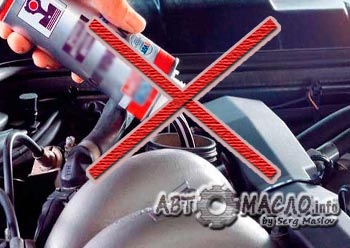 Let's go further — say you pour some "engine flush" chemical in along with the oil that's already worked its time. It's obvious enough that this chemical has to contain some active substances, otherwise flushing as such loses any meaning. Are you a chemistry expert? Do you know how these substances might react with the internal parts of the engine? Do you have any guarantee that the flush won't eat away at, say, the rings in your engine?
What's more, by adding a flush to the old oil, you substantially change its properties, and above all we're talking about oil viscosity. You change it quite drastically — by a factor, I'd say, or more. Then you drain out that old oil, and... lo and behold, up to 10% of it stays in the engine (depending on the engine's design)! Don't believe it? Then check, at least by way of comparison, how much oil the manufacturer's specifications say your engine should hold, and how much oil you usually pour in.
Let's keep imagining: you pour in new oil, and it mixes not with the old oil anymore, but with something else entirely, and absolutely certainly not something suited to your engine. And the share of this hellish mixture in your new oil is a full 10%! For reference, in normal oil roughly 85% of the composition is the base oil, and another 15% is additives. So, in effect, this way you're adding almost as many "additives" to your oil as it already contains. Except the action of these "additives" is unpredictable, because they're certainly not the ones the engine manufacturer had in mind. Should we go on?
Everything said above, by the way, applies to any additives sold separately for any purpose for use in engine oil. Let's say it again: third-party additives and supplements in engine oil can only do harm to the engine, and they're sure to do it — try to take that on board.
It's much the same picture when flushing oil is used, only there the active substances are probably fewer, so the negative result won't show up quite as fast.