API SQ and ILSAC GF-7: what do the new classes on the can mean?
Or what the API “doughnut” and the ILSAC “starburst” are telling you
In this section: 5 articles
A familiar picture: your car’s service book says API SL or SM, while the shop shelf offers SN, SP and SQ, some cans with a “starburst”, others with a kind of shield, and the salesman tells you confidently that “SQ is the newest class, so it’s the best and suits everything”. He is half right. How the classifications work in general has already been covered in the article on engine oil quality classifications; this one is about what stands behind each new letter and what it means for your engine.
An American Petroleum Institute (API) class is not a “good or bad” mark but a list of tests the oil has passed. A new class appears when a new problem appears in engines, and new tests are added to the old ones.
From SM to SQ: what each class added
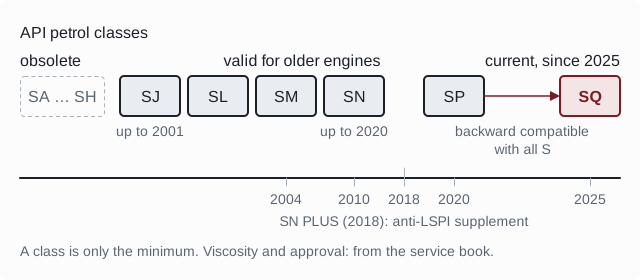
API SM was approved in November 2004. Since then the engines themselves have changed: naturally aspirated engines are increasingly giving way to small 1.0-1.5 litre turbo engines with petrol direct injection. The oil in them has a harder life: on short trips fuel gets into it, soot appears (yes, in a petrol engine), and the turbocharger runs hotter.
SN and SN PLUS
API SN appeared on 1 October 2010. An SN oil with the Resource Conserving mark matched the ILSAC GF-5 of the day, meaning it had also proved its fuel economy. API still recognises SN, but now only for engines built in 2020 and earlier.
SN PLUS, on the other hand, is not a separate class but a supplement to SN, which API introduced on 1 May 2018 as a stopgap: the new ILSAC GF-6 was running late, and turbo engines needed protection there and then. Protection from what? From low-speed pre-ignition, LSPI. At low revs and high load a droplet of oil and fuel ignites in the cylinder before the spark plug fires, and the pressure jumps so sharply that it can break engine parts. And here the oil is no innocent bystander but part of the problem: calcium detergent additives make LSPI more frequent, while magnesium in place of part of the calcium, and molybdenum, make it rarer (more in the article on LSPI in turbo engines). SN PLUS is no longer licensed on its own: SP and SQ have taken over its job.
SP and SQ
API SP came into force on 1 May 2020 together with ILSAC GF-6, and the LSPI tests became part of the class itself. The second novelty of SP is a timing chain wear test (Sequence X). Soot from direct injection packs in between the rollers and links of the chain, and the chain gradually stretches. The oil is run for 216 hours in a two-litre Ford EcoBoost engine, and the chain must not stretch by more than 0.085%. Stricter requirements on deposits on the pistons and in the turbocharger were added as well.
API SQ has been licensed since 31 March 2025, together with ILSAC GF-7. It asks more of the oil than SP does: the limits on deposits, oxidation, sludge and chain wear are tighter, and LSPI protection is now checked not only on fresh oil but also on oil that has already done some work. And SQ with the Resource Conserving mark (which is, in effect, GF-7A) also proves better fuel economy and that the oil holds on better to the phosphorus from its anti-wear additives: less of it ends up in the exhaust, poisoning the catalytic converter. SQ is backward compatible with all earlier S classes — that is, where the manufacturer calls for SL, SM or SP, an SQ oil will do (provided, of course, the viscosity and approval are the ones in the service book).
API is in no hurry to strike the old classes off. SP is still licensed alongside SQ, and SJ, SL, SM and SN are still recognised, but only for older engines (SJ for cars built in 2001 and earlier, SN up to 2020). Everything up to and including SH is considered obsolete: an oil like that may simply fail to protect a modern engine.
The “starburst” and the “shield”: ILSAC GF-6 and GF-7
A can may carry three marks. The round API “doughnut” shows the class (S or C), the SAE viscosity and, if it applies, the Resource Conserving mark. The “starburst” means the oil is certified to ILSAC GF-7A, and the “shield” to GF-7B. ILSAC is the “International Lubricant Standardization and Approval Committee”, which in practice means the requirements of American and Japanese carmakers for petrol engine oils. The difference between the two marks is a matter of principle: GF-7A covers the viscosities usual for ILSAC, xW-20 and xW-30 (0W-20, 5W-30, 10W-30 and so on), while GF-7B is 0W-16 only, an oil for engines specially designed for it. Don’t look for a “starburst” on 5W-40 or 10W-40: ILSAC does not certify those viscosities. And the “shield” is not a badge of higher quality but a warning: this oil is not for just any engine (more in the article on 0W-16 and 0W-8 oils).
Besides the tighter limits already mentioned, GF-7 puts the stress on two more things: how well the oil pumps in frosty weather, and keeping its properties over the whole change interval, not just the first few thousand kilometres.
Now about the shelves. The GF-6A and GF-6B classes were due to lapse on 31 March 2026, but API extended the transition period, and from 1 October 2026 GF-6 oils lost the right to the “starburst” and the “shield” and dropped out of the API directory. Even so, cans made earlier will be sitting in the shops for a long while yet. The oil in them has not got any worse — the new class simply asks for more. The easiest way to tell them apart is the class in the “doughnut” next to it: SP with Resource Conserving is still GF-6A, SQ with Resource Conserving is already GF-7A.
And what if your car’s owner’s manual specifies an older ILSAC class, GF-5 or GF-6A? Here API’s own advice is simple: take a GF-7A oil of the viscosity the carmaker specified. The key words are “of the viscosity”: a “starburst” is no substitute for the right viscosity.
And what about diesels: CK-4, FA-4, CL-4 and FB-4
The API diesel line lives a life of its own. It was first split in two on 1 December 2016, when CJ-4 was replaced by two classes at once: the backward-compatible CK-4, and FA-4, with a lowered high-temperature viscosity for some on-road (lorry) engines built in 2017 and later, which is no longer backward compatible. Both classes are current, and API has not announced a date for declaring them obsolete (whereas everything from CG-4 back is already history).
API split the next step in two as well. API CL-4 is the successor to CK-4 for viscosities such as 15W-40 or 10W-30, and it is backward compatible. API FB-4 is the lower-viscosity branch, the successor to FA-4 (all the way down to xW-20), only for engines whose manufacturer has expressly provided for it. The reason is the American limits on nitrogen oxide emissions for lorries of the 2027 model year: the oil has to offer better oxidation stability, better wear protection and less phosphorus, sulphur and ash, so as not to damage the exhaust after-treatment systems. CL-4 and FB-4 will first be licensed from 1 January 2027.
For the owner of a diesel car this is, as a rule, a side issue: the API diesel classes are written first and foremost for lorries, and for diesel cars of European makes what matters is the ACEA classes and the carmaker’s approvals.
What does this mean for the ordinary car owner?
So the salesman is half right: a new API petrol class does, as a rule, replace all the earlier ones. And here is the other half.
1. A new class suits an old engine too, but it is not obligatory. If the service book says SL, an SQ oil will do. Whether to pay extra for it when the right SN or SP oil is on the shelf is up to you: it will do no harm, but it will work no miracles either.
2. The class does not cancel out the viscosity and the approval. An SQ oil with a “shield” and 0W-16 viscosity is also the “newest” class, but it must not go into an engine for which the manufacturer specified 5W-30. And if the service book lists a carmaker’s approval, that carries more weight than any API class. A carmaker usually builds its approval on top of some base class with tests of its own, so a class without the approval cannot replace it; and it also happens that an oil with a European approval has no API class on the can at all.
3. A GF-6 “starburst” on an old can is no reason to panic, but where ILSAC is required, it is better to take GF-7A of the right viscosity (and for 0W-16, GF-7B with the “shield”).
4. With a diesel, go strictly by the manual. CK-4 where CK-4 or CJ-4 is required; FA-4 and FB-4 only where the engine manufacturer has expressly provided for them.
Let me say it once more: a new letter on the can is only the minimum standard of quality, and it is still the manufacturer of your car who decides which oil goes in. The service book first — approval, class, viscosity — and only then the “doughnut”, the “starburst” or the “shield”.