Is welding cast-iron parts possible?
In this section: 57 articles
- 3D wheel balancing
- A driving instructor for experienced drivers
- A woman's car
- Choose genuine Peugeot parts from AvtoGlobus!
- What's an online store for?
- Body parts for the Nissan X-Trail T31 in your city
- Reliable reverse cameras and factory-fit head units
- Number plate theft
- Statoil car oils, lubricants and petrol
- Original Parts for Foreign Cars
- Parts for foreign cars: where to buy?
- Types of screw compressors
- How to bleed air from a BMW clutch actuator
- Replacing a damaged BMW driveshaft boot
- Car-wash chemicals: effective products
- Original Japanese Auto Parts: An Alternative to an Engine Swap
- Kia car seat covers
- Dry cleaning your car's interior
- Types of tuning
- Bike-mounting accessories
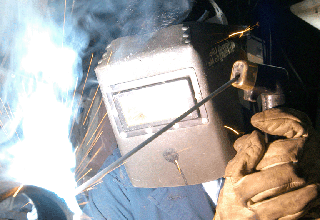 There's a common view among car owners that failed (cracked) cast-iron components can't be repaired. Meanwhile, since these are important and expensive parts, in most cases there's serious money at stake. In reality, cast iron can absolutely be welded, it just takes special equipment and an experienced specialist. Here's how it's done.
To create permanent joints between parts and assemblies when repairing seats and fittings, buckets, frames prone to cracking, and boom housings, argon welding is used. It makes it possible to carry out the full range of work with aluminium, titanium, stainless steel, cast iron, copper, silumin, ferrous metals, non-ferrous metals and duralumin. It's more reliable than brazing and other types of welding, since it creates a solid barrier protecting the weld zone from oxygen. This process is carried out in an environment of inert argon gas, which prevents aluminium oxide from forming. The very high quality of the weld makes it possible to use this method in a variety of environments.
In argon-arc welding of aluminium, an argon torch and filler material — aluminium wire — are used. The edges of the wire and the parts being joined are melted by the electric arc that forms between the torch's non-consumable tungsten electrode and the workpiece. At the same time, the argon fed through the torch's nozzle prevents the arc, the electrode and the weld surface from oxidising. Once welding is finished, the seats are bored out on special equipment. High-quality cast-iron welding is widely used to restore and manufacture parts and assemblies made from cast iron or its alloys. It joins parts and assemblies firmly. This welding process is divided into hot and cold.
Hot welding of white and grey cast iron makes it possible to produce welded parts that are equal in quality to the metal being welded itself. It's carried out at high welding current and continuously until the welding process is complete. Before work begins, the part being welded is itself heated to a certain temperature using induction heating. To prevent cracks forming in the part, it must be cooled down gradually.
Cold welding of cast iron is done in several ways, depending on process and certain economic factors, as well as the required quality of the joint between parts. It includes: welding with steel or cast-iron electrodes, welding with non-ferrous metal electrodes, and welding in a carbon dioxide environment. When using electrodes with stud placement, it's possible to weld in vertical, flat and overhead positions, which achieve greater joint strength. It shouldn't be used for items that will operate at temperatures above 100 degrees C. Once cast-iron welding is finished, the seats need to be bored out. This is done to a precision matching the part's required dimensions.
So, in many cases a cracked cast-iron car part can absolutely be restored, but before doing so, you must always consult specialists.