Renting heavy machinery - the advantages
In this section: 36 articles
- Mitsubishi Lancer X - changes and specifications
- Diagnosing a car “by eye” - picking an accident-free car
- Renting a car abroad? Easy as pie!
- Phoenix Motors - a Suzuki dealer in Petersburg
- Ford Focus
- The Ford Explorer - a great car for active, sporty owners
- Attention to detail matters most when choosing a car
- Car Valuation Is a Job for Professionals
- Test drive: the Toyota RAV4
- Automotive news from the Subaru group
- The car and the road: believe in your own abilities!
- What's New in OSAGO for 2010
- Car rental in Turkey
- Where do wrecked cars end up?
- Audi Centre Petersburg: official Audi dealer
- Moscow car pawnshops during the crisis
- How to safely buy a car over the Internet
- Sale of confiscated cars by Ukrainian banks
- Advantages of the express car buy-back service
- Choosing your first car
People generally get used to good conditions quickly, often forgetting the effort it took to get there. An expensive car, a well-paid job, a comfortable flat, a well-kept plot and a cottage. But behind that beauty, behind that comfort, there's often some fairly demanding development work, into which a great deal of effort and time has gone. And to make that development work easier, all sorts of machines are used everywhere, letting various processes run dozens of times faster and accomplishing what manual labour simply can't manage.
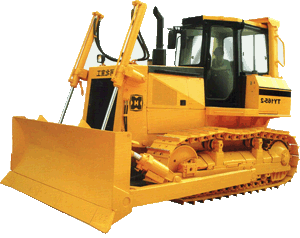 One category of equipment that helps both with developing a plot and with building a house is heavy machinery. Dump trucks bring in building materials, cranes and loaders handle loading and unloading work, and an excavator-bulldozer digs out soil and moves it around the site. Concrete mixers and rollers speed up the construction process and take on the tough work without which building would take dozens of times longer.
Within heavy machinery, besides the different types (dump trucks, loaders, cranes, rollers, concrete mixers, graders, and so on), there are also differences in configuration. For example, the same tractor can be fitted with excavator attachments, lawn-mowing equipment, a device for breaking up and removing soil, a hydraulic hammer, and so on. There's also a difference in what platform the machine is built on: ordinary wheels or a tracked base. A tracked bulldozer, for instance, has better traction in the difficult conditions you might find outside the city. But that's not needed on paved construction sites, so it's more sensible to use wheeled machines there.
But it often happens that a construction company's own arsenal doesn't include the particular piece of heavy machinery needed for a certain job. In that case, renting the equipment is a good way out. And some kinds of construction work aren't needed all that often. So thanks to a rental agreement, many construction companies can use machinery for certain jobs without spending huge sums on buying new equipment.
Take a company building a house out of town, for example. Dump trucks are used to bring in building materials, and loaders and mobile cranes make it easier to move materials around. But for drilling a borehole, or digging out ground for a well or a pond, the equipment used is rented. Sometimes a homeowner wants ten metres of asphalt connecting the garage to the nearest road. In that case, renting an asphalt roller is a cost-effective solution for the construction firm. There's no need to buy expensive machinery just for that one need.
There are also situations where a construction firm's fleet does include a certain type of machine, but not enough units of it to meet demand. A bulldozer, for instance, is common heavy equipment, and renting one may be needed during heavy snowfalls, to clear construction sites and the approaches to them. The whims of weather are often unpredictable — even forecasters can't guarantee how much snow will fall in winter, which makes it hard to work out how much equipment is needed to clear it. So renting heavy machinery is always a lifesaver when bad weather hits.
Sometimes the client's own requirements, or the conditions of building the site, call for a broader technical base to carry out the construction work. In cases like that, renting a bulldozer or other heavy machinery is often simply the only way to solve the problem.
But for all its apparent simplicity, renting heavy machinery isn't such an easy business. Sometimes a rental agreement turns out to be poorly drafted, incorrect, or deliberately unfavourable. It can happen that renting a bulldozer hides some pitfalls, and an inexperienced representative of the construction company ends up causing some loss or cutting into the profit from the build. That's why construction companies, unless they have a professional lawyer on staff, always turn to the relevant legal firms for help.