How to determine the quality of petrol?
In this section: 5 articles
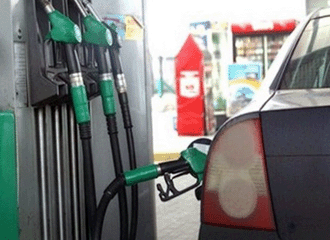 Every car owner without exception worries about petrol quality. After all, many engines, especially modern ones, are extremely sensitive to fuel quality, and trusting the local filling stations is, sadly, a scary thought. The consequences of filling up with bad fuel are familiar to most car owners: loss of power, rough running (especially at idle), and in the worst case a complete failure of the fuel system, which makes it impossible to keep driving without a trip to a garage. Figuring out how well a given fuel meets the required standards is quite hard. Let's go through, one by one, the characteristics of good petrol.
First, let's start with colour. Remember that fuel is actually colourless. The one exception is A-76, which is less clear because it contains more impurities than AI-95 and AI-98.
Many people wonder whether it's possible to tell the quality of petrol on your own. We all understand that when engine knocking appears and power drops, the fuel you bought was low-quality. In modern cars (and this isn't limited to premium models — it applies, for example, to the popular Hyundai Tucson), the onboard computer that controls fuel injection also reacts instantly to poor fuel. The driver immediately sees a "Check engine" warning on the dashboard. To avoid such consequences, try the methods below to check how well your petrol meets quality standards.
1. Wet a sheet of paper with a small amount of petrol. Blow on it gently to let the liquid evaporate. Check the result. If the sheet stays pure white, that fuel can be trusted. If a greasy mark or an unwanted tint appears, it's better not to buy that petrol. It contains various impurities.
2. The amount of resins in the fuel is determined like this. Light a drop of petrol placed on a piece of glass. If you see white marks shaped like rings, there are either no resins at all or only a negligible concentration. If the colour is brown or yellow, be careful — the resin content is fairly high, which can do real harm to the engine. This method will also help you tell whether other substances are present in the petrol. For instance, small remaining droplets on the glass indicate that the fuel contains diesel oil.
Note that the acceptable amount of resin depends on the grade of petrol and is 7-15 mg per 100 ml. Keep in mind that if the resin concentration doubles, your engine will wear out 20% faster. That's why we strongly recommend taking your choice of filling station just as seriously as your choice of engine oil.
3. Fill a clear container with petrol and hold it up to the light. It should have a faint yellowish tint when held up to light. Then add a solution of potassium permanganate. Check the colour now. If the solution turns pink, that means water is present.
4. Another method: apply a small amount of petrol to your skin. Good-quality fuel will leave a dry patch on your hand. If it leaves a greasy trace instead, you can be sure impurities are present.
5. And the last, simplest way to check — by smell. If it smells of sulphur, hydrogen sulphide, naphthalene or other unwanted substances are quite likely present.
The most important thing when running these tests is to be careful! Combining petrol with an open flame is dangerous!