10 rules of winter driving
In this section: 5 articles
So, your first “car winter” is coming up — what do you need to know to keep the risk of an accident to a minimum? Does winter driving instruction even exist? How should you behave on a slippery road, and should you drive in winter at all? Let’s try to answer a few of these questions.
First of all, your car needs to be properly prepared for winter. This isn’t just about winter tyres — every major system needs preparing. Before the cold sets in, it’s strongly advisable to check and, if needed, replace all the service fluids (engine oil, power-steering fluid, brake fluid, and the fluids in the transmission and suspension units), the battery, and all the rubber suspension components: ball joints, tie-rod ends, bushings and so on. And, of course, fit winter tyres (on all four wheels). The spare wheel should also be “shod” in a winter tyre!
Whether or not to drive in winter is your call, but bear in mind that a long standstill — even in a heated garage — isn’t exactly good for your car either, and provided you follow a few simple but important rules, winter driving isn’t much more dangerous in terms of potential accidents than driving in summer. In short, it’s in your hands. Let’s try to set out the rules that every driver should follow in winter, regardless of experience, skill, motorsport achievements or any other credentials:
1. No sudden movements. Neither with your hands nor your feet. If you’re behind the wheel, sudden movements are inadvisable in any season, but in winter they’re an order of magnitude more dangerous, and the consequences far more tragic. So everything is done smoothly, gradually: turning the wheel, braking, pulling away, easing on or off the throttle.
2. Bring your speed in line with the traffic code. The old saying that traffic rules are written in blood is especially true in difficult road conditions, black ice among them. What’s at stake is nothing less than a life — yours, your passengers’, and other road users’. Don’t forget that up ahead, some Joe Bloggs may well be breaking the rules in his old banger, and once you spot him at the last moment, you won’t be able to simply “swerve” out of the way and avoid a collision the way you would in summer. You’ll have a split second to decide: ram him, or veer onto the pavement full of people, into a ditch, a field, a forest, a tree, a pole, an oncoming or a parked car (take your pick). And all of it can end very badly indeed — unless, of course, you’re travelling at a speed that lets you stop in time even on a slippery road and let the idiot past. Don’t take away your own chance to survive. Just don’t.
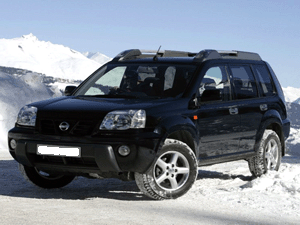 3. No excessive self-confidence. If you’ve taken extreme-driving courses, which many driving schools offer, you should have been told that all extreme-driving skills exist only for extreme situations and for calming the driver by reinforcing confidence in their own abilities. Using — or, worse, trying to reproduce — stunt-driver tricks like handbrake turns is only for special test grounds, never for the road, even if it seems empty right now. A second later, that same Joe Bloggs may come flying out of a dark side street (or from behind a building), quite possibly the worse for drink. The result is the same as described in point 2.
4. Double your following distance, or better yet, triple it. Believe me, you’ll arrive at work only five minutes later if two, or even ten, hurried drivers cut in ahead of you in traffic (even in a jam), but you’ll lose hours waiting for the police if the car in front of you brakes sharply because that same Joe Bloggs turns out to have better tyres, or drier asphalt under his wheels.
5. Always warm up the car! This isn’t just about the minimum warm-up the engine and gearbox need. It’s primarily about the windscreen and the cabin temperature — the steam and condensation on the glass. Poor visibility and driver discomfort are not the best companions on a tricky, slippery road.
6. In freezing weather, there’s no such thing as a dry road! Even if you seem to be driving on dry asphalt right now, no one can guarantee that 500 metres ahead some other driver hasn’t spilled water the day before, or that a street sweeper hasn’t piled snow from the pavement onto the road. Always remember how unpredictable the road surface can be.
7. Always keep a spare bottle of windscreen washer fluid in the boot. Even if you’ve just filled the tank all the way up, buy an extra litre just in case. No one knows when it will run out, or how far it is from that spot to the nearest petrol station (or shop). And a hundred metres is quite enough for real trouble to start.
8. No unnecessary lane changes. Try to keep lane changes to a minimum — if you need to turn left even two kilometres from now, get into the left lane straight away, and let them flash and honk behind you; ignore it, a sensible person doesn’t chase gaps like that. As for weaving between lanes to get from point A to point B faster — forget about it in winter. You should never be in a hurry behind the wheel, but in winter it really is a matter of life and death.
9. Get out of a snowdrift as smoothly as possible. If your car has “dug in” or simply got buried in snow overnight, there’s no need to panic and spin the wheels on the ice — you’ll only make things worse. Try to clear the snow away from all the wheels within at least half a metre, then work your way out of the drift by “rocking” (this only works with a manual gearbox), pulling away in second gear. Getting out of a drift on an automatic is considerably harder — you’ll either need to find some helpers or put boards, sand or similar under the drive wheels. As a last resort, if nothing else is available, try letting some air out of the drive wheels (not all the way, but enough to be clearly visible — down to about 0.5–0.7 atm). But this last measure only makes sense if you have a working compressor (pump) in the boot and can reinflate the tyres straight away.
10. A separate word of advice for owners of all-wheel-drive cars and SUVs. An all-wheel-drive car accelerates on a slippery road faster than a two-wheel-drive one (all else being equal), but they brake at roughly the same rate. So having all-wheel drive on a slippery road gives you practically no advantage in terms of safety. Traction, yes — but not safety, so don’t let your guard down; everything written above applies to you just as much as to owners of two-wheel-drive cars.
In closing, it should be said that in every case, the foundation of safe driving, in any season, is the ability to react adequately to what is happening on the road. A winter road is fundamentally different from any other in that it is unpredictable — you can never know what the road will be like even 300 metres ahead, what the surface will be, who might suddenly dart onto it, and how it could all end. So the main rule of winter driving is: don’t be in a hurry, anywhere, and drive carefully.
Whether you should take special extreme-driving courses is up to you, but you should understand that these courses still won’t let you drive faster or more aggressively in winter — that’s unwise and dangerous regardless of anything else. If you do decide to use an instructor’s services, remember that a good driving school’s prices aren’t the deciding factor — don’t choose the cheapest option, choose the one that will genuinely help you improve your skills.
We also recommend: criteria for choosing a driving schoolP.S. Joe Bloggs, mentioned throughout this article, is a fictional character — any resemblance to real people or events is purely coincidental.