How to choose a driving school
In this section: 5 articles
 So, your child has grown up, or your wife has "ripened" for driving a car. What's the right way to go about it – can you just buy a licence, do you need accident-avoidance driving courses, and how do you even choose a driving school when there are so many of them these days, nearly all private? Let's try to work through it all in order, as usual, with a bit of logic and common sense.
What's at stake isn't small – it's a life.
When choosing a mainstream school for their child, wise parents look at attendance statistics, feedback on the teaching staff, the learning conditions themselves, and other "little things" that a child's future – no less – depends on. But when it comes to choosing a driving school, for some reason most people look at what's closest and cheapest. And then, watching the day's crash reports on the news, they're baffled: "where do drivers like THAT even come from?" Well, they come from exactly those driving schools that are "closest and cheapest" – or their parents (husbands) just buy them a licence outright.
You need to understand that attending a good driving school is your only real chance and opportunity to learn to drive and to behave properly on the road – don't fool yourself into hoping that a freshly minted driver will sit down and study the traffic rules on their own after getting their licence, because that won't happen. Think about it – when did you last read the traffic code yourself? That's exactly why buying a licence is categorically out of the question, under any circumstances! Even if you learned to drive 15 years ago without any driving school at all – remember, back then there were far fewer cars on the streets and driving was a lot simpler!
"Hard in training, easy in battle"
Nobody has repealed that phrase from the great commander, so the first rule you need to take on board is: don't look for the easy way. What do you actually need here: a piece of paper (a licence), or preparing your wife (child) to hold their own independently in a flow of other cars, at any time of day, in any season, behind the wheel of any car? If it's the latter, don't even try to make the learning process easier – that can only do harm.
The first temptation you'll run into when choosing a driving school is location – many future drivers choose a school purely on the criterion of "closest to home". In reality, given how simple it is today to set up a private driving school, it's by no means guaranteed that the school closest to your home is good, or even capable of teaching anyone anything at all. So in a conscious choice of the institution that's going to teach you or someone close to you to drive, geography should rank somewhere around 15th place, right after price. What should come first is the quality of instruction, the statistics and the reviews (read about the criteria for choosing a driving school).
Quality training is never cheap
Unfortunately, that's just how it is. To properly teach someone to drive and behave on the road, you need a qualified specialist – a driving instructor – who isn't going to work for peanuts. You also need premises, teaching materials, posters and a lot more besides. And finally, you need quite a lot of time and an individual approach. All of that, as you can imagine, doesn't exactly line up with entering the "Cheapest Driving School" competition.
That said, this absolutely doesn't mean the more expensive the training, the better the quality – so the only thing you should rule out "without a second look" is the very cheapest options.
Which car is best to learn on?
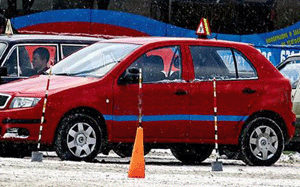 You need to understand that in many countries, a licence obtained after training on an automatic-transmission car comes with a special restriction that doesn't allow that graduate to drive a manual-transmission car. What's more, as practice shows, people who've learned to drive a manual-transmission car end up understanding and feeling an automatic transmission better later on, and consequently handling it more correctly. So even if your family isn't planning to buy a "stick-shift" car, that still doesn't mean you have to train exclusively on an automatic. The ideal option here is to split the overall practical course into two halves, one on a manual, one on an automatic. Check right away whether the driving school you've chosen can actually offer that.
On top of that, you categorically shouldn't train on small cars, even if your family owns one just like it (small). It's much easier to get used to smaller cars after starting on bigger ones than the other way around. On top of that, the specifics of driving (and, accordingly, of training) on front-, rear- and all-wheel drive differ substantially, so it's better to choose the drive type that the future driver will mostly be driving.
Do you need accident-avoidance driving courses?
The decision to attend courses like this should be made by the driver themselves, and only once they already have at least 10-15 thousand kilometres of independent driving experience behind them. Taking these courses right after driving school makes no sense at all, because they just turn into ordinary practical driving lessons. Let's be honest – it's hard for a driving instructor to teach someone the precise sequence of hitting the brake pedal, turning the wheel and pulling the handbrake (a controlled slide) if that person still occasionally mixes up the pedals and barely remembers where the handbrake is? So before signing up for accident-avoidance courses, it's worth building up a certain amount of experience and skill behind the wheel first – and that only comes from practice, meaning careful, everyday driving.
When is the best time to learn?
In my view, the ideal time to train at a driving school is winter, so that the whole course of practical lessons falls right in the toughest road conditions. What's more, if the licence is obtained at the start of spring, the freshly minted driver will still have half a year to build up some practical experience before the next winter comes around. Either way, you need to understand: the tougher the road conditions during the practical lessons, the better-prepared the driving school's graduate will be for driving in any conditions at all.
Further reading: What criteria to use when choosing a driving school – what to pay attention to