12 criteria for choosing a driving school
In this section: 5 articles
 Before making a final decision on which driving school to choose, you should definitely go and visit it. And the best time to do that is during working hours, while classes are actually in session. Here are the criteria you should pay attention to first. Let me say right away: "closer to home/work" and "cheaper" aren't on this list.
- A licence. If there are no issues with the paperwork, a decent driving school usually doesn't wait for a prospective client to ask to see the licence — a copy is displayed somewhere visible in the area open to visitors. If the details on the licence match the sign and the address you've come to, you've passed the first test and can continue your inspection.
- The documents the driving school issues. Once legal training is complete, a driving school authorised for this kind of activity is required to issue a certificate of course completion, along with a driver's card bearing a photo and passport details. If you're told about an "international certificate," you're most likely dealing with a semi-legal course that preps future drivers to sit the police exam externally. It's better not to get involved with those — at the very least, you're unlikely to come away with any real knowledge or skills.
- People (specialists). Try talking to the driving school's instructor directly (ask a few questions), and try talking to the driving instructors too. That alone will quickly tell you, at a minimum, whether good rapport with these people is even possible. Without rapport, no training is effective. Talk to the school's own students as well — try to find out whether they're happy with the training process.
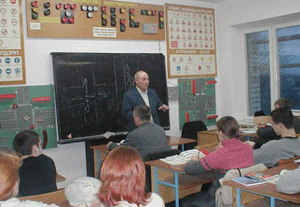
- Classrooms. Don't be lazy — take a look at the classrooms. The setting, floor space and equipment alone are usually enough to tell you whether you can actually gain any knowledge there or not. Ultra-modern driving simulators and computers aren't mandatory, but at the very least there should be teaching materials and visual aids.
- Class group size. Teaching anything to a group of more than 20 people is practically impossible — or so teachers say. So find out in advance how many students this driving school enrols per group. And make sure the size of the classrooms matches that number.
- The curriculum. A decent driving school teaches quite a lot. Granted, the depth of vehicle-construction theory once taught in Soviet-era driving schools is no longer really needed by the average driver, but knowing the operating principles of the main systems and assemblies will definitely help you run your car properly and save you a fair amount of money down the line on unnecessary trips to the garage. Knowledge of first-aid procedures, meanwhile, could one day save someone's life, or at least significantly ease the consequences of an injury. In any case, simply "drilling" students on the police exam question bank (which happens a lot at cheap driving schools) is of absolutely no use — that kind of knowledge has no practical value beyond passing the exam itself.
- The class schedule. You need to work on the assumption that every class has to be attended, and at a good driving school that's not a burden, because the classes are genuinely interesting. So make sure the school's class schedule fits the routine and schedule of the person who's going to study there. Many driving schools hold classes in the evenings and on weekends, so there's no need at all to give up your job (or studies) to train there.
- Number of practical lessons with an instructor. Whatever you're told, the minimum practical driving course for someone with no prior driving skills should be 35-40 hours. If the basic course package includes fewer hours than that, find out the cost of each additional hour with an instructor above the set minimum, and be sure to add the missing hours to your total training expenses.
- The schedule and routes of practical lessons. Can the instructor pick you up at home (or at work) at a time that suits you? Are the routes used for practical lessons varied? Does the instructor know the standard routes used later for the police exam, and are those routes used in the practical lessons?
- The cost of training and practical lessons. Many driving schools use marketing tricks to make their services look cheaper on paper — for example, listing fuel costs, and sometimes even vehicle depreciation, as a separate line item instead of including them in the base training price. So you need to find out right away exactly what expenses, beyond the base training fee and (if needed) additional practical lessons, await you from the start of training through to getting your driving licence.
- The driving school's vehicle fleet. You'll want to know the size, drivetrain and gearbox type of the cars used for practical lessons. Does the school have vehicles suited to you (see above), and will you be able to choose your own car for practical lessons, or are they assigned among students, say, by drawing lots?
- Sitting the police exam. This is a very important point — you need to find out exactly when the driving school's obligations to you end, and what happens next if you don't pass the exam on the first attempt (unfortunately, that does happen). A good driving school usually doesn't just drop a student off at the police station door and considers them a client right up until they get their driving licence. You may have to pay extra for preparation ahead of a second attempt, but that option should be available to you.