How to choose a genuinely good driving school
In this section: 36 articles
- Mitsubishi Lancer X - changes and specifications
- Diagnosing a car “by eye” - picking an accident-free car
- Renting a car abroad? Easy as pie!
- Phoenix Motors - a Suzuki dealer in Petersburg
- Ford Focus
- The Ford Explorer - a great car for active, sporty owners
- Attention to detail matters most when choosing a car
- Car Valuation Is a Job for Professionals
- Test drive: the Toyota RAV4
- Automotive news from the Subaru group
- The car and the road: believe in your own abilities!
- What's New in OSAGO for 2010
- Car rental in Turkey
- Where do wrecked cars end up?
- Audi Centre Petersburg: official Audi dealer
- Moscow car pawnshops during the crisis
- How to safely buy a car over the Internet
- Sale of confiscated cars by Ukrainian banks
- Advantages of the express car buy-back service
- Choosing your first car
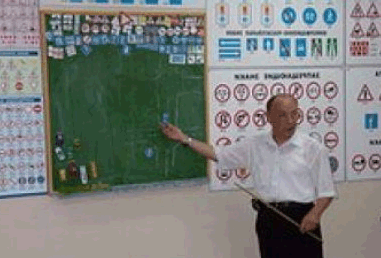 Do you value your time, your money, and above all your life? If you answered yes to that question, then you'll take choosing a driving school fairly seriously. After all, just one wrong move on the road, or one misread sign, can cost you a fair few hundred dollars – or your life altogether. Most people, while they're still just would-be drivers, choose a driving school by a few standard criteria – how close the school is to home, how long the course takes (so they can finish it faster and get their hands on that piece of paper called a "licence"), and price (to keep the cost down – why pay those instructors anyway?!). People who think this way are deeply mistaken. For the laughably small amounts most driving-school students are willing to pay, nobody is going to teach them properly. If you're offered a shortened course, you can forget about quality instruction altogether.
So if you want to properly learn to drive, look for a genuinely proper driving school to match. To start, you can ask people you know – maybe one of them will recommend something suitable, and then you won't have to waste time searching any further. If not, look in the internet or in local magazines and newspapers for the phone numbers of driving schools whose lessons you can more or less afford. Then pick up the phone and call all of them. Don't be shy, ask about everything that interests you – the cost of training, the training cars, and their licence. Once you've narrowed it down to two or three favourites, you don't need to call anyone else – go straight to the schools you've chosen to find out more detail about how things work there. Once you're there, ask to see the classrooms where the lessons take place. If there are no computers, no driving simulators, no traffic-light models, no posters, you can forget about that school right away. If everything's in place, ask to see the fleet of cars, find out whether the cars have pedals on the instructor's side, what condition the cars themselves are in – or better yet, see it all with your own eyes. If there's nothing to complain about there either, and neither the old cars nor instructors playing dominoes raise any red flags, then ask to see their licence. Everything in order? If so, find out whether you'll have to pay extra separately for petrol or for practical lessons (at some driving schools it's standard to pay for practical and theory lessons separately).
Find out: does the certificate you'll be issued right after finishing the driving school course meet all the traffic police's standards? Ask what share of this school's graduates pass the traffic police exam on their first attempt. If it's over 60%, that's a very good indicator, and you don't need to worry too much about the quality of training here. But still, ask to talk with your potential future instructor – of course, you'll only be able to judge their human qualities, not their actual professionalism, but even that is sometimes worth quite a lot. Also find out whether the driving school you've chosen offers any other additional services besides training. In good schools, they can also give you advice on choosing a new car or on insuring it, or offer courses to improve your driving skills further. Also, some driving schools, given that most of their students are already busy adults with no time to run around clinics all day to get the required medical certificate, bring the medical panel to the school itself. So now, having weighed up all the pros and cons, you'll be able to choose a genuinely good driving school for yourself – one that will turn out a real driver, not a driver in name only.