What factors shorten the service interval?
What factors affect the engine oil change interval?
In this section: 10 articles
- How often to change the oil?
- Manufacturer recommendations
- How do manufacturers calculate the interval?
- Oil change interval (Longlife)
- What factors shorten the service interval?
- How to determine the oil change interval?
- On oil change frequency
- In brief: about “snowdrops”...
- In Brief: The “Weekend” Car...
- In brief: about traffic jams...
The main ones are the season, the driving pattern, and the quality of the fuel and consumables. Some car and engine oil manufacturers give different recommendations for how often to change engine oil depending on operating conditions. In particular, you'll come across a definition like "severe" operating conditions, under which the engine oil is supposed to be changed more often.
So what exactly are "severe" conditions?
Oddly enough, it's nothing like what a lot of car owners imagine. Without diving too deep into the physics and chemistry of what happens inside an engine, we can pick out the main driving modes that are "severe" for an engine and substantially cut short the life of the engine oil. So, "severe" conditions include:
1. Irregular use of the car, or long breaks in operation. Remember the old saying – "a car should be driven every day"? That's exactly how it is. An engine that's started once a week, or, say, isn't started at all over winter, needs a lot more attention, more frequent oil changes, and, in all likelihood, will have a shorter life than an identical engine that runs every day.
That's exactly right, and it comes down to the condensation that forms inside the engine during long periods sitting idle. Mixed with the combustion products of petrol or diesel fuel, this condensation becomes a fairly effective acid that eats away at the engine from the inside. So when a car market seller tells you a story about how grandpa only drove the car to the supermarket once a week, that's actually pretty dubious marketing from the standpoint of the car's real condition. But since in 99% of cases it's not even true anyway, and is really just cover for a shamelessly rolled-back odometer, there's not much point worrying about it too much.
2. Regular short trips. How many kilometres is it from your home to work? Have you ever noticed how much of your morning (and, correspondingly, evening) drive happens with the engine still below its working temperature? In other words, are you even sure your engine has time to fully warm up during the drive to work? It's the condensation issue again, with all the consequences that come with it. Especially relevant in winter.
3. Traffic jams and stop-start driving. If you remember your school kinematics course, you'll know that the maximum load on an engine happens when pulling away from a standstill. It's precisely at those moments that the oil heats up the most and loses its properties the fastest.
4. Driving in mountainous terrain, towing a trailer, and constantly driving a loaded car. Once again, this means extra load on the engine, which leads to premature oxidation and thickening of the engine oil.
5. Running the car in dusty or polluted air. Have you ever noticed that in any well-run country your shoes are just as clean in the evening as they were in the morning? You might think there's less dust there. Maybe so, but the main reason is that they wash the streets there! Regularly, in every season. And it's precisely for those clean streets, with very little dust and dirt on them, that European car manufacturers calculate the time it takes for engine oil to simply get dirty and lose all its properties. It's precisely for those streets that air filters are designed, the ones you replace along with the engine oil. And that's exactly why the service books for foreign cars so often say the air filter only needs replacing once every 60,000 km!
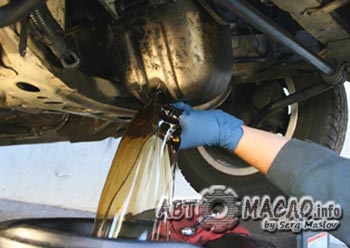 6. Poor fuel quality. This one's pretty self-explanatory – anything that doesn't burn off in the cylinders ends up settling in the engine oil and substantially reduces its effectiveness. So you need to understand that the recommended oil and consumable change intervals for European cars are written based on European fuel quality. What Fedya the fuel-station attendant, who's just siphoned a canister of petrol out of the tank for his own Zhiguli, tops the tank back up with – the Germans wouldn't dream of it in their worst nightmares. And the factory-quality fuel coming out of the pump is genuinely very different in Europe versus here – that has to be admitted.
7. Traffic jams and engine idling. While the engine sits running at idle, the cooling system's effectiveness drops substantially and the oil heats up.
So it's clear that the ideal operating conditions for a car are regular long trips in an unloaded car at moderate speeds on clean European roads, and on top of that running on European fuel. If your conditions differ from that, you need to adjust the car manufacturer's recommendation for how often to change the engine oil. In the direction of shortening it, obviously.
8. Vacuum, or so-called express, oil changes.