Computer Diagnostics for Your Car
In this section: 57 articles
- 3D wheel balancing
- A driving instructor for experienced drivers
- A woman's car
- Choose genuine Peugeot parts from AvtoGlobus!
- What's an online store for?
- Body parts for the Nissan X-Trail T31 in your city
- Reliable reverse cameras and factory-fit head units
- Number plate theft
- Statoil car oils, lubricants and petrol
- Original Parts for Foreign Cars
- Parts for foreign cars: where to buy?
- Types of screw compressors
- How to bleed air from a BMW clutch actuator
- Replacing a damaged BMW driveshaft boot
- Car-wash chemicals: effective products
- Original Japanese Auto Parts: An Alternative to an Engine Swap
- Kia car seat covers
- Dry cleaning your car's interior
- Types of tuning
- Bike-mounting accessories
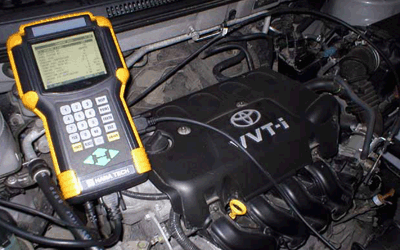 It's common knowledge that starting around the mid-1990s, leading car makers moved away from carburetors entirely and switched to electronic fuel-injection control systems in petrol engines. In most such systems, injection is managed by a small onboard computer that receives data on the engine's current operating regime from sensors mounted on the engine and its ancillary equipment.
That little computer therefore always knows what regime the engine is running in and the state of the sensors that let it control injection. In most cases, these onboard computers also have a memory block that stores information about any faults in engine operation.
Alongside the rollout of computer-based engine management systems, car makers also introduced service computers that let technicians at official dealerships read out the current performance of the fuel system, along with any faults that appeared over the service interval.
Today, computer control has long since stopped being limited to the fuel system — in modern cars, computers also manage automatic transmissions, braking systems, climate-control systems, active and passive safety systems, in short, the operation of nearly every major system in the vehicle. What's more, signal encoding and service connectors keep becoming ever more standardised: for instance, on most modern cars the service computers connect through a CAN bus and an OBD-2 service port.
Given all this, the question of computer diagnostics for cars becomes ever more relevant. Just a few years ago, special scanners for reading data from a car's onboard computers were available only to authorised service centres, but today such devices are mass-produced and available to most car owners.
It should be noted that doing your own computer diagnostics has clear advantages (saving money, no need to wait in line or drive to a specialised station, and so on), but also drawbacks. Chiefly this comes down to the fact that properly interpreting the onboard computer's fault codes and readings requires specialised knowledge and technical documentation. So in most cases, an autoscanner can help a car owner figure out that a fault exists somewhere in a given system, but to actually fix it you're still better off going to a professional.
System autoscanners
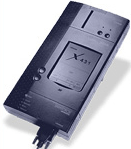 The Launch X-431 autoscanner is currently the most widely used system-diagnostics tool. That's largely down to its price-to-quality ratio. For a relatively modest price, the scanner comes with powerful software. It also includes a base kit of 25 adapters, including one universal adapter that lets it diagnose virtually any car found on the Russian market.
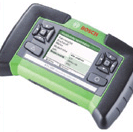 The direct competitor to the Launch X-431 is the Bosch KTS scanner. While it doesn't come with as large a set of adapters (Bosch scanners include an OBD II adapter and a universal adapter), the "Bosch" autoscanners offer very capable software, not just for system diagnostics but also for informational and technical support. At the same time, the Bosch ESI{tronic} software lets you diagnose not just passenger cars but virtually any commercial vehicle as well.
For more details on system-diagnostics equipment, or any other garage and diagnostic equipment, you can consult the Di-Zel company. If you're working out how to set up an auto-repair business (a car wash, a tyre shop...) from scratch, take a look at their licensed auto-service design services. The company's specialists, with their extensive experience, will design your auto-service centre or car wash, calculate the utility systems and lay out the equipment for any project, whether it's a small tyre shop or a large service centre.
If you see your service centre or technical centre heading in the direction of car diagnostics, then you simply need to choose equipment that can cover as much of the vehicle fleet as possible and that receives regular software updates. You can order an equipment demonstration at your own service centre and see for yourself how well it suits your needs.
A related line of business is organising satellite tracking for commercial and private vehicles. The company's specialists install satellite-tracking equipment on site, which is very convenient, especially for commercial fleets. Clients are also given a server platform for real-time tracking from any computer with internet access.