Buying wheel rims: what to look out for?
In this section: 57 articles
- 3D wheel balancing
- A driving instructor for experienced drivers
- A woman's car
- Choose genuine Peugeot parts from AvtoGlobus!
- What's an online store for?
- Body parts for the Nissan X-Trail T31 in your city
- Reliable reverse cameras and factory-fit head units
- Number plate theft
- Statoil car oils, lubricants and petrol
- Original Parts for Foreign Cars
- Parts for foreign cars: where to buy?
- Types of screw compressors
- How to bleed air from a BMW clutch actuator
- Replacing a damaged BMW driveshaft boot
- Car-wash chemicals: effective products
- Original Japanese Auto Parts: An Alternative to an Engine Swap
- Kia car seat covers
- Dry cleaning your car's interior
- Types of tuning
- Bike-mounting accessories
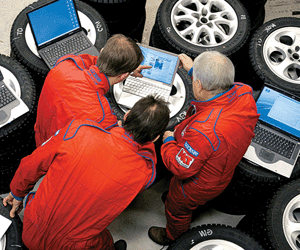 Quite often you need to replace not just the tyre but the rim under it too. The question comes up: which rim to choose, what to look at when buying one, and really — which rims will actually fit your car?
First, check the manufacturer's documentation — it's bound to have data on wheel rims. If you can't find the documentation, you can ask a service centre or tech centre. Sure, you could go with genuine rims, but they're not always readily in stock, or they may not fit, especially on an older car.
If you can, work out whether the rim will actually fit your car. For instance, will it foul the suspension, the brake assembly, and so on? Do the mounting points match your hub? That could be a sphere, a washer, a cone seat — whatever it is, it needs to match. Calculations show that it's the first three threads that "hold" the load, so check the whole fastening for tightening down to 5 threads. At the same time, make sure the bolts aren't too long for the rim — otherwise they can damage the ABS sensor or the handbrake. All of this is worth knowing before heading to the tyre shop, whatever type of rim you're planning to buy: forged, steel, or cast.
Before buying wheels, be sure to check the tyre size you're planning to run, or already run, against the climate in your region. Sure, there's a temptation to buy all-season wheels, but keep in mind that means settling for "neither one thing nor the other" — any summer tyre will beat an all-season one in summer, and any winter tyre will beat it in winter. And, of course, factor in where you'll actually be driving — dirt roads out to the dacha, or daily commuting strictly within city limits.
By the way, anyone interested in tyre news will be curious to learn that Michelin has come up with a new version of its premium tyres, along with an Anti-Surf system that delivers maximum grip on wet surfaces without fear of hydroplaning. Meanwhile Brillantis has released an improved economy-class tyre, whose main feature is a new asymmetric tread pattern that gives better grip and stability.
The temperature is creeping up: time to start thinking about summer shoes for your car, especially since right now you can find better prices than at the height of the season, and tyre centres aren't as busy either.