ACEA classes today: what is left and what is new?
Or why a “newer” ACEA class does not mean a better one
In this section: 6 articles
One can says “ACEA C3”, the one next to it says “ACEA C6”, and the salesman is happy to explain: six is more than three, so the oil is newer, and newer means better. The logic looks watertight: in the American API classification the next class really does, for the most part, replace the earlier ones. But the European one works quite differently. In ACEA a new class is a different class, not a better one, and a C6 oil in an engine designed for C3 can do a fair amount of harm.
The ACEA requirements (ACEA being the European Automobile Manufacturers’ Association) are written by the people who build engines, for the engines they build. In short, an ACEA class is a set of requirements an oil must meet to suit a particular type of engine: with a particulate filter or without one, designed for normal viscosity or for reduced viscosity.
What is left of the 2004 edition
The 2004 edition has already been covered in the articles on the ACEA classification and on decoding its classes. Since then ACEA has rewritten its requirements more than once, and since 2021 it has issued separate documents for cars and for trucks. For cars the 2023 edition is in force; for heavy-duty diesels, the 2024 edition.
Over these years some classes have disappeared altogether. A1/B1 has been gone since 2016, A3/B3 and C1 were withdrawn in 2021, and the heavy-duty E6 and the later E9 have given way to E8 and E11. The reasons are quite prosaic. A3/B3 was once split off from A3/B4 for prechamber diesels, and nobody has made such engines for years; C1 was hardly ever required by any car manufacturer. In their place came A7/B7, the classes from C4 to C7, and the first class of the new heavy-duty F series, F01.
The year of the edition is written after the class with a hyphen: “A3/B4-23” means A3/B4 in the 2023 edition. Oil made to the previous edition may only be sold for two years after the new one comes out: oils carrying the 2022 heavy-duty edition, for instance, could be sold until 1 October 2026. Even so, cans with the suffixes -21 or -22 still turn up on the shelves, and as a rule there is nothing terrible about that: what has to match your service book is the class name itself. Old owner’s manuals, however, nobody rewrites, and they may well list A3/B3 or C1. In that case go by the manufacturer approval listed next to it, and if there isn’t one, ask the brand’s official representative which current class replaces it.
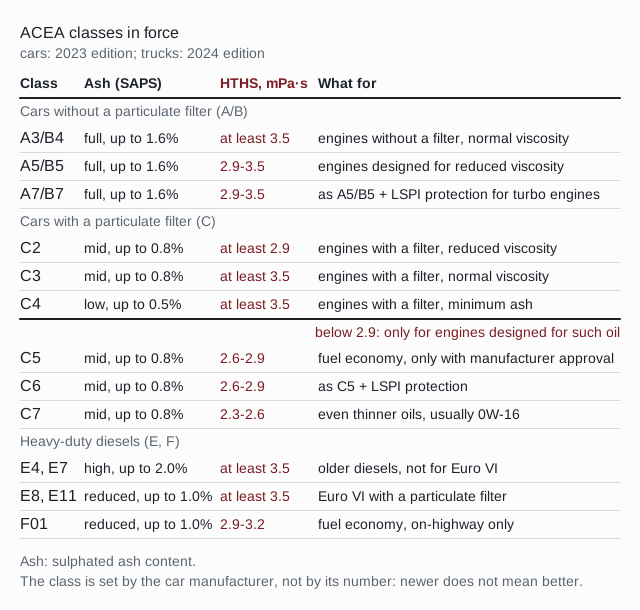
Cars: A/B and C
For cars the ACEA classes are split into two families. A/B are full-ash oils (up to 1.6% sulphated ash) for engines without a particulate filter. Three of them are left. A3/B4 is the classic “thick” oil, with a high-temperature viscosity (HTHS, more on that below) of at least 3.5 mPa·s, for engines designed for normal viscosity. A5/B5 is a reduced-viscosity oil for engines designed to run on it. A7/B7 is the same as A5/B5, plus protection for direct-injection petrol turbo engines against low-speed pre-ignition (LSPI) and wear, and for diesels against deposits in the turbocharger compressor.
C are oils compatible with catalytic converters and particulate filters. They contain up to 0.8% ash, and C4 no more than 0.5%. There are six classes here, from C2 to C7.
Particulate filters and low-ash oils
The abbreviation SAPS stands for sulphated ash, phosphorus and sulphur. All of these get into the oil with the additives, and that is where they are needed. But every engine burns a little oil, and everything that was in it goes straight into the particulate filter.
Soot the filter can burn off: every so often it heats up and whatever has built up burns away. Ash, however, cannot be burnt, just like the ash in a stove: the logs have burnt, the ash is left, and someone has to rake it out. Ash in the filter does not burn but accumulates; you can’t get it out without removing the filter, and the more ash there is in the oil, the sooner the filter will need cleaning or replacing. These substances do the catalytic converter no good either, and it is no accident that ACEA states plainly that C-class oils extend the life of both the filter and the catalytic converter.
The particulate filter used to be a diesel affair. But with Euro 6c the particle number limit for direct-injection petrol engines was brought into line with the diesel one, and most new cars with such engines got a filter too. So the question “A/B or C?” now concerns the owner of a petrol car as well. If the car has a particulate filter and the manufacturer requires a C-class oil, an A/B oil must not go in there, however “thick”, “reliable” or cheap it may be.
HTHS: how C3 differs from C5, C6 and C7
The second boundary that divides the C classes is high-temperature HTHS viscosity. In plain terms, it is the viscosity of the oil at 150 °C and a very high shear rate, as in the crankshaft bearing shells, for example: it decides whether the oil film holds there (why lowering it without the manufacturer’s consent is dangerous is covered in detail in the article on reduced oil viscosity). In the C classes the boundary runs like this:
1. C3 and C4: HTHS of at least 3.5 mPa·s, as in the full-ash A3/B4. These are oils for engines with a filter, designed for normal viscosity.
2. C2: at least 2.9 mPa·s, for engines designed for a reduced-viscosity oil.
3. C5 and C6: from 2.6 to 2.9 mPa·s. C6 differs from C5 in the same way as A7/B7 differs from A5/B5: it protects petrol turbo engines against LSPI and diesels against turbocharger compressor deposits.
4. C7: from 2.3 to 2.6 mPa·s, an even thinner oil (as a rule 0W-16), built on C6 for still lower fuel consumption.
See? The ranges of C3 and C5–C7 do not even overlap. A C3 oil cannot be C5 or C6 at the same time, and vice versa: they are oils for different engines. ACEA itself says that C5, C6 and C7 are meant only for engines designed for such viscosity and for which the manufacturer has approved it. So a “newer” C6 in place of the C3 prescribed for your car is simply a thinner oil meant for someone else’s engine. There is a separate article on the very thin 0W-16 and 0W-8 oils.
Trucks: E8, E11 and the new F01
Heavy-duty diesels have a document of their own, but the logic is the same. E4 and E7 are high-ash (up to 2.0%) and meant for older engines; ACEA does not recommend them for Euro VI engines. E8 and E11 have reduced ash (up to 1.0%) precisely for such engines. HTHS in all four is at least 3.5 mPa·s.
The 2024 edition also brought F01, the first class of the new F series: essentially the same E11, only thinner for the sake of fuel economy (xW-30 viscosity, HTHS from 2.9 to 3.2 mPa·s). It is meant for on-highway vehicles only, not for off-highway machinery. Same story as with C3 and C5: F01 is not “better” than E11, just thinner, and it may only go where the truck manufacturer has provided for it.
How do you choose the ACEA class for your car?
Let me say it once more: oil is chosen by the car manufacturer’s requirements, and ACEA has changed nothing there.
1. Service book first. It gives the class, and often the manufacturer approval too. The approval matters more: as a rule it is built on some ACEA class and adds the manufacturer’s own tests to it (the Mercedes-Benz MB 229.52 approval, for instance, is built around C3, and MB 229.71 sits at C5 level). More on this in the article on what oil approvals are.
2. Got a particulate filter? Look for a C class on the can, and precisely the one the manufacturer specified.
3. Don’t compare the numbers after the letter: a bigger one does not mean a better one. C6 is not “better” than C3, just as A7/B7 is not “better” than A3/B4.
So an ACEA class should be read not as a grade but as an address: it tells you which engine the oil was made for. If the address on the can matches the one in your car’s service book, buy it and don’t give it another thought. If not, no “newer” numbers will put that right.