0W-20, 0W-16, 0W-8: is the oil too thin for your engine?
Or can you put “Japanese” 0W-16 into an ordinary engine?
In this section: 8 articles
The common belief is that the thinner the oil, the easier life is for the engine: less friction, lower fuel consumption, easier cold starts. Sellers are happy to agree, and on the shelves next to the familiar 5W-30 and 5W-40 stand cans marked 0W-20, 0W-16, 0W-12 and even 0W-8. Owners of new Volkswagens, Mercedes-Benz and BMW cars or a hybrid Toyota find these figures in their service books, and owners of older cars find them in the advice of “experienced” friends: the oil is modern, they say, so it can’t do any harm. Does that mean you can now pour such oil into any engine? No, and I will say it once again: the oil’s viscosity must match what the carmaker requires, however fashionable it has become.
The opposite question is just as common: if the service book says 0W-16 and such “water” frightens you, why not pour in something thicker, to be on the safe side? Let us deal with both.
What are SAE 16, 12 and 8?
You most likely already know how to read a viscosity grade: the first figure, with the letter W, is about cold starting, the second about the oil’s viscosity in a warm engine. It is this second scale that has been extended downwards. The Society of Automotive Engineers (SAE) added grade 16 to its J300 standard in 2013, and grades 12 and 8 in 2015. So 0W-16, 0W-12 and 0W-8 appeared: oils that simply are not in the old table of viscosity values.
To understand how they differ, you will have to remember one abbreviation: HTHS (high temperature, high shear, that is, viscosity at high temperature and a high shear rate). In plain words, HTHS is the oil’s viscosity where the engine has it hardest: in the thinnest film between a crankshaft journal and its bearing shell, at 150 °C and high revs. It decides whether the oil film holds in a heavily loaded friction pair or metal starts touching metal.
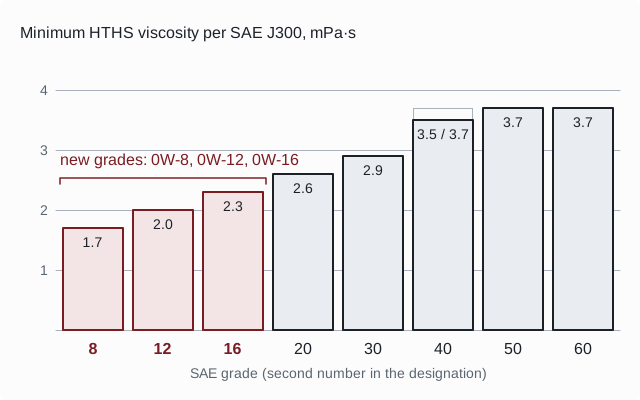
For each grade the SAE standard sets a minimum HTHS (in mPa·s): at least 2.9 for SAE 30, 2.6 for SAE 20, 2.3 for SAE 16, 2.0 for SAE 12 and only 1.7 for SAE 8. For comparison, the “forties” 0W-40, 5W-40 and 10W-40 must hold at least 3.5, and 15W-40 and thicker oils as much as 3.7. In other words, in a hot, heavily loaded component 0W-8 may have half the viscosity of a familiar 5W-40.
Why do carmakers want oil this thin?
The answer is banal: fuel. Thinner oil is easier to pump and easier for the engine’s parts to “stir”, so less energy goes into friction, and with it less fuel and less CO2, and carmakers are held strictly to account for emissions these days.
So the thin oils were followed by approvals and classes made for them:
1. 0W-20 with European carmakers’ approvals. At Volkswagen these are VW 508 00 and 509 00 for the EA211 evo and EA288 evo engines: viscosity 0W-20, HTHS no lower than 2.6, and the oil itself is even tinted so that it is easier to recognise. At Mercedes-Benz they are MB 229.71 and 229.72 (0W-20, at the level of ACEA C5), and at BMW Longlife-17 FE+. What else has changed in the approvals you can read in the article on the new Mercedes, VW and BMW approvals.
2. 0W-16: the ACEA C7, ILSAC GF-7B and JASO GLV-2 classes. The European Automobile Manufacturers’ Association (ACEA) added class C7 in the 2023 edition of its classification: HTHS no lower than 2.3, as a rule 0W-16. ILSAC (the “International Lubricant Standardization and Approval Committee”) has had a separate category for 0W-16 since GF-6B; its current version is GF-7B, and it is for 0W-16 only. Such oils are marked not with the familiar API “starburst” but with a “shield”, precisely so that nobody mistakes them for oils meant for every other engine. The Japanese have a class of their own too: in 2024 the “Japanese Automotive Standards Organization” (JASO) added GLV-2 for 0W-16 and 0W-20 oils whose viscosity changes less with temperature.
3. 0W-12 and 0W-8: JASO GLV-1 and BMW. JASO issued the GLV-1 standard back in 2019, for these two viscosities only, and it tests the oil’s fuel economy on a Toyota hybrid engine. Some Toyota hybrids are filled with 0W-8 at the factory. And in Europe 0W-12 turns up at BMW too: its own Longlife-22 FE++ approval for certain petrol engines, which has nothing to do with JASO.
What do all three points have in common? Each of these oils is made for specific engines designed precisely for it, not as an “improved” version of the familiar oil for everyone.
Why is it no good for an older engine?
I have already described the general picture in the article on too-low oil viscosity: oil that is too thin cannot hold its film where the load is greatest. Now for what the new grades have changed. An engine built for an HTHS of 3.5 was designed by its engineers around a thicker film, one that carries the load at high revs and high temperature, and its bearing shells and the whole lubrication system are calculated for it. An engine built for 0W-16 is calculated for 2.3. Pour 0W-16 into an engine that needs 3.5, and in the hot, loaded component the viscosity will be lower than designed: by the SAE minimums that is 2.3 against 3.5, a third less. The result: faster wear of the bearing shells and cylinders, and higher oil consumption. And you will not notice it straight away, but only when nothing can be put right any more.
The difference here is roughly that between a sheet and a duvet. In a flat built with good heating a sheet is quite enough, and it is easier to sleep under. But at the country cottage in November you will not last till morning under a sheet alone, however good and expensive it is.
That is why these oils are not backward compatible, and carmakers say so plainly: oil with the VW 508 00 or 509 00 approval must not be put into engines that require 504 00 or 507 00. So “the oil is modern, it can’t do any harm” is exactly the case where it can. A newer approval or class for thin oil is not “better”, it is different, for different engines: at BMW, for example, a newer Longlife number does not automatically replace the previous one. With the API and ILSAC classes it is another matter: there the newer class, as a rule, covers the older one, but not when the can carries the “shield” and says 0W-16.
And the other way round: thicker oil in a “thin-oil” engine?
All right, you will say, thin oil is out for an older engine. But what if, in a car whose service book says 0W-16, you pour in a proven 5W-30, as a safety margin? No again. An engine designed for thin oil counts on the oil reaching every component quickly after a start and, once running, having exactly the viscosity its engineers built in. With thicker oil the engine runs with more friction and at a higher temperature than intended, burns more fuel (losing precisely what it was designed that way for) and wears faster. For more on the consequences, read the article on too-high oil viscosity.
It is another matter if the manufacturer itself allows not one viscosity for the engine but a range, say 0W-16 or 0W-20. Then you may choose, but only within that range. A “safety margin” beyond the limits the carmaker allows is not a margin but an experiment at your expense.
What does this mean for the ordinary car owner?
Nothing new: the old rule has simply become stricter. The order is this:
1. The service book or owner’s manual. It gives both the viscosity (or range of viscosities) and the approval or class. If it says 5W-40 and, say, ACEA A3/B4, walk past the 0W-16 without a second glance, however much it is praised.
2. The approval matters more than the figures. 0W-20 with the VW 508 00 approval and 0W-20 “for Japanese cars” are different oils, even though the figures on the label are the same. Look on the can for exactly the approval given in your service book, and remember: “meets the requirements” is a promise from the oil maker, not approval from the carmaker.
3. A used car is a separate question. Neighbouring model years of the same model may have engines of different generations that require different oils (at Volkswagen this is exactly the case with the evo engines). So find out from the VIN or from the brand’s official dealer exactly which engine your car has, not which one they “usually fitted”.
So very thin oils are not a new “quality level” but oils for specific engines designed especially for them. If your car’s service book says 0W-16, pour in 0W-16 and do not lose sleep over it. If it says 5W-40, all the more reason not to experiment.
Further reading: