Using anti-gel additives in winter
In this section: 7 articles
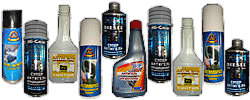 With the arrival of winter and the season of hard frosts, most diesel-powered vehicles develop faults that make the engine hard to start. The main reason lies in the diesel fuel itself, where falling temperatures cause long n-paraffin chains to form, which then settle in the fuel lines and filters. In this case there's no getting around parking the car in a heated garage, but you should steer clear of warming the fuel system components directly with an open flame, or of adding petrol to the tank.
The first approach is extremely dangerous to the driver's life, and the second is dangerous for the car itself. Given this, in winter you need to use either special cold-resistant diesel fuel or pour-point depressant additives, such as anti-gel. At the same time, there's a school of thought that if you're already filling up with non-freezing, cold-resistant diesel fuel, special additives like diesel anti-gel aren't really necessary.
But that's not entirely a sound judgement, since right now nobody can guarantee that the liquid poured into your car actually matches cold-resistant standards flawlessly. Even if it does meet its stated parameters, pour-point depressant additives will still raise its resistance to sub-zero temperatures further, without doing any harm to the fuel system components.
In other words, anti-gels are additives specially designed for diesel fuel that hold back the formation of n-paraffin chains, thereby significantly improving and protecting the engine itself and the diesel fuel delivery system from the harmful effects of sub-zero temperatures — and no better solution has been found yet. To prove this, let's look at the approaches that improve cold-resistance parameters and cut n-paraffin content.
Chemically speaking, diesel fuel is obtained by heating crude oil in a rectifying column, separating out petrol, kerosene and diesel fuel from one another in the process. The cold-resistant fraction of diesel fuel forms at a temperature of minus 320°C, and comes out to only a quarter of the total volume — in other words, "real" cold-resistant diesel would actually have to sell for 1.5 times the price of standard diesel fuel. Another way to strip out the paraffins is by adding urea and zeolites to the diesel fuel, but that method is also extremely costly, which is why manufacturers today use neither the first nor the second method.
As for pour-point depressant additives — anti-gel — the way it works is based on synthetic ethylene or methacrylic acid copolymers binding to the n-paraffin compounds, which slows their growth as the temperature drops. As a result, the diesel fuel flows freely through the fuel system, given that diesel anti-gel is noticeably cheaper than pulling the engine apart after the usual methods of "starting" or trying to start the car in the frost.