Antifreeze today: G12evo, G13 and why colour tells you nothing
Or why “red” and “green” say nothing about what is inside
In this section: 12 articles
- In brief: on changing transmission oil
- Choosing coolant
- Coolant
- In brief: gear oils
- Tosol and antifreeze, our car's technical fluids
- Ethylene glycol and other achievements protecting your car
- Using anti-gel additives in winter
- What is antifreeze?
- Antifreeze today: G12evo, G13 and why colour tells you nothing
- DOT 4 LV brake fluid: what to top up with and when to change it?
- ATF, CVT and DSG: what goes into modern gearboxes?
- What oils and fluids does an electric car need?
It is generally believed that antifreeze comes in two kinds, “old” and “new”: green or blue is something like Tosol, red is “modern”, and if there is red in the reservoir, red is what you top up with. Sellers at the market are happy to back this theory, and meanwhile purple, yellow and pink cans have turned up on the shelves too. In fact, colour tells you almost nothing about what is in the fluid. The dye is there mainly so that you can see the level in the expansion tank; what actually protects your engine is written not in colour but on the label, in the form of the car manufacturer’s approval.
Why an engine needs antifreeze and why you cannot simply fill it with water instead has already been covered in the article on what antifreeze is. This one is about what the fluids themselves have become and how not to get lost among them.
Glycol, glycerine and water
The basis of any antifreeze has not changed: a mixture of glycol and water. Mixed in the right proportion, it both stays liquid in a hard frost and boils later than water, which is why concentrate is always diluted (and only with distilled water). As a rule the glycol is ethylene glycol, less often propylene glycol.
What is new is glycerine. A modern antifreeze may be based not on glycol alone but on a blend of ethylene glycol and glycerine. The American Society for Testing and Materials (ASTM), in its D3306 standard for passenger-car coolants, used to distinguish concentrates and ready-mixed 50 per cent solutions based on ethylene and propylene glycol, and later added two more types: a concentrate and a ready-mixed fluid based on ethylene glycol with glycerine.
Volkswagen’s G13 is an example: part of the glycol in it is replaced with glycerine, and making such a fluid produces less CO2. Will your engine notice? No. But if the car’s manufacturer specified G13, then G13 is what goes in, not “the same thing, only cheaper”.
Additive packages: from Tosol to Si-OAT
Glycol takes care of frost and boiling, but it is the additive package, the inhibitors, that protects the metal from corrosion. Put simply, there are four families here (roughly in the order they appeared):
1. IAT — inorganic inhibitors. Silicates, phosphates, nitrites. This is the classic green antifreeze and Soviet-style Tosol. The additives in such a fluid wear out relatively quickly, so it has to be changed more often.
2. OAT — organic acids. No silicates, a long service life. Fluids like these are where “long-life” antifreeze began.
3. HOAT and Si-OAT — hybrids. Organic acids plus a little silicate. This is the chemistry European carmakers mostly choose; G12evo belongs to this family too.
4. P-HOAT (P-OAT) — organic acids with phosphates. As a rule, these are the fluids of Japanese and Korean carmakers. There are also fluids in which both silicates and phosphates are added to the organic acids (PSi-OAT).
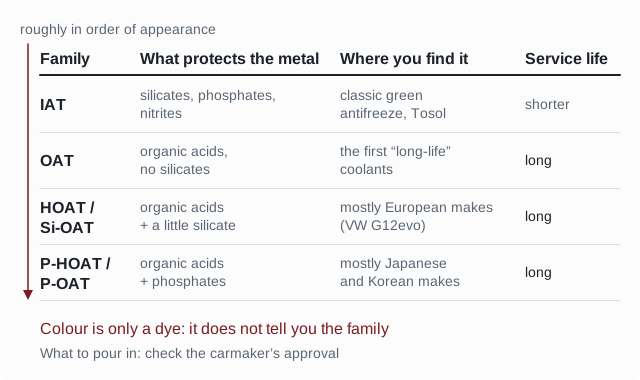
Different additive packages mean different chemistry, designed for the metals, gaskets and hoses of a particular engine. And none of these families has a colour of “its own”: the same red dye can go into a fluid with silicates and into a fluid with phosphates.
And what about Tosol? Tosol is a first-family fluid, made in its day to a Soviet GOST standard, and many people still regard the name as a mark of quality. But more than 90% of Soviet GOST standards ceased to be valid in Ukraine as far back as 1 January 2019, so “made to GOST” on a can is no longer a standard you can rely on. The standard for your car is in its service book.
Carmakers’ approvals: G12evo, G13 and the rest
As with engine oil, the last word here belongs to the car manufacturer. Volkswagen shows this most clearly: each of its fluids has both a popular name with the letter G and the number of a factory standard, TL 774:
- G11 (TL 774 C) and G12 (TL 774 D) — fluids of the 1990s; together with G12+ (TL 774 F) they have since been superseded by newer ones;
- G12++ (TL 774 G) — according to Audi, from the 2005 model year;
- G13 (TL 774 J) — from the 2008 model year, with glycerine;
- G12evo (TL 774 L) — from the 2019 model year, an Si-OAT hybrid.
Today the manufacturer allows G12evo in Audis of every year of manufacture (with one exception, for a particular diesel), and the electric Audi e-tron may be filled with nothing else. Incidentally, in an electric car the coolant also looks after the battery, so the requirements for it are different there (more in the article on which fluids an electric car needs).
Now about colour. Within that same Volkswagen group, G11 is greenish blue, G12 is red, and G12+, G12++, G13 and G12evo come in shades of purple. Four different fluids from one manufacturer look almost identical in the reservoir — never mind fluids from different manufacturers.
So look on the label not for the letter G and not at the colour, but for the exact specification of your car’s manufacturer (for Volkswagen, TL 774 with the right letter). What an owner risks by pouring in an “equivalent” the carmaker has not approved is covered in the article on analogues and substitutes.
Can you mix them, and how often should you change them
The short answer: better not. The additive packages of different fluids may not get on with each other: the mixture loses its stability, and some of the additives drop out as sediment or form jelly-like deposits that clog the fine channels of the radiator and the heater matrix. Rather like pouring borscht and stewed fruit into one saucepan: each is good on its own, together they go in the bin. Only here it may be the cooling system that goes in the bin, and after an overheat the engine with it.
Even Audi, all of whose fluids are shared with the rest of the Volkswagen group, distinguishes three cases in its service table: which of these antifreezes can be mixed in any proportion, which only at the cost of weaker corrosion protection, and which must not be mixed at all. And even after a permitted mix the manufacturer advises changing the fluid (in its table only G12++ and G13 are fully compatible with each other). Whereas nobody has ever checked a random can from a filling station for compatibility.
So the old topping-up rules we have written about before still stand: top up with the same fluid that is already in there (if you do not know what that is, look in the service book or ask the brand’s official dealer), and in a hopeless situation use distilled water, then change all the fluid in the system. One more rule has joined them. Switch to a different fluid only with a complete change: the old antifreeze is drained completely, the system is flushed with water following the manufacturer’s procedure, and only then is the new one poured in.
The change interval, on the other hand, has become both simpler and more complicated at once. Long-life fluids last far longer than Tosol, and on many cars the first change in the service book comes only after many years. Audi even writes in its service bulletin that its coolant needs no changing at all. But that applies to the right fluid in a sound system. If the antifreeze has turned cloudy or brownish, if sediment has appeared, or if after several top-ups nobody knows what is in the reservoir any more, change it without waiting for any due date. The same goes for a used car whose service history you do not know.
So antifreeze is chosen the same way as engine oil: not by colour and not by the word “antifreeze” on the label, but by the car manufacturer’s approval. As for whether it is red or purple, let that worry the people who design the cans.
Further reading: