General recommendations for storing and using chains
In this section: 77 articles
- DIY repair of tubeless tyres
- General recommendations for storing and using chains
- Equipment for pumping heavily contaminated fluids
- Packaging board and its properties
- Inflating tyres with inert gases: myths and reality
- SULPHIDE CAPACITY AND OPTICAL BASICITY OF STEELMAKING SLAGS IN STEEL PROCESSING
- What to look out for before fitting a car alarm
- A profiled-sheet rolling mill
- Insulated glass units: the window's key element
- A Group Surprise
- Nanotechnology in everyday life
- The market for demand and consumption of PET strapping in Russia
- Generating electricity at home
- The advantage of using a garage
- ABS, EBD, BAS and other active safety systems
- All types of manual transmission (MT)
- What to give a car owner, and not only a car owner
- Installing a water pressure reducer and why it matters.
- A few tips for an office move
- What types of car paint are there, and why do you need car-care chemicals
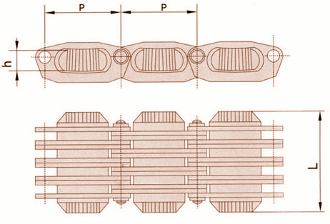 Chain drives are components found in the mechanisms of virtually all industrial equipment, vehicles and devices. Their components are strictly standardised and high quality. Even so, they still need care.
Peculiarities of using chains:
-
Roller chains and others must be installed and operated strictly in accordance with the requirements and rules set out in the technical documentation or in the datasheet for the mechanism they're used in.
-
While using the product you must strictly follow the requirements of the regulatory documentation under which that chain was manufactured.
-
It's impermissible to carry out any manipulations of the chains aimed at changing their characteristics, properties or design features without consulting the manufacturer.
-
If a variator chain or any other chain is being put into service for the first time, it's mandatory to obtain the manufacturer's agreement and advice on using the product, its operating conditions and the servicing schedule.
-
If the devices are meant to operate under difficult or extreme conditions (extremely high or low temperatures, elevated humidity, high linear chain speeds, short-term peak loads, aggressive contamination and so on), you also need to agree the operating conditions and peculiarities with the supplier.
-
Before mounting new chains onto a drive mechanism, a careful check of shaft axis parallelism and sprocket axis alignment is required.
-
Each type of product is designed to operate under specified conditions. Accordingly, using devices similar in size but belonging to a different type than intended by the equipment's design features is impermissible. For instance, using one type of roller chain in place of another risks dangerous consequences. Keep in mind that individual components of different chain types are made from different materials and have different fatigue and load-bearing characteristics.
Recommendations for storing chains:
Right before transport, to provide corrosion protection, a layer of preservative lubricant with a dissolved inhibitor should be applied to each product. Here the storage method itself is an important factor. The mechanisms must be kept in a dry, enclosed space with controlled air humidity. A variator chain or any other chain kept in storage for a long time must undergo periodic re-preservation as specified in the requirements of the regulatory-technical documentation.
The chain drive should be lubricated regularly, using exclusively high-quality lubricant matching the type and mode of operation of the device. The lubrication method depends on the properties of the lubricant and the speed of the chain drive. At high operating speeds, the quality of the lubricant matters even more.