Generating electricity at home
In this section: 77 articles
- DIY repair of tubeless tyres
- General recommendations for storing and using chains
- Equipment for pumping heavily contaminated fluids
- Packaging board and its properties
- Inflating tyres with inert gases: myths and reality
- SULPHIDE CAPACITY AND OPTICAL BASICITY OF STEELMAKING SLAGS IN STEEL PROCESSING
- What to look out for before fitting a car alarm
- A profiled-sheet rolling mill
- Insulated glass units: the window's key element
- A Group Surprise
- Nanotechnology in everyday life
- The market for demand and consumption of PET strapping in Russia
- Generating electricity at home
- The advantage of using a garage
- ABS, EBD, BAS and other active safety systems
- All types of manual transmission (MT)
- What to give a car owner, and not only a car owner
- Installing a water pressure reducer and why it matters.
- A few tips for an office move
- What types of car paint are there, and why do you need car-care chemicals
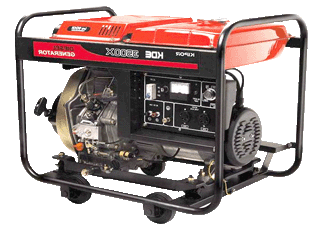 There was a time when making ice cream at home was considered an exotic pastime reserved for the chosen few. Today you can provide yourself not just with exquisite food, but even with your own water, heat and electricity.
City dwellers are gradually moving out to the outskirts, or even out of town altogether, into what's known as the "private sector." A private cottage is prestigious, convenient, fashionable and cosy. If you want, you can make your home fully self-sufficient and supply it with all the utilities it needs, whenever and however much you need.
If you're able to buy a diesel generator, for instance, then choosing where to build your house is no longer tied to whether a centralised power grid reaches it. With its help you can fully power all your household appliances and lighting, heat the house through winter cold, and cool it in summer heat. Practical and affordable, these power plants are even used at large industrial sites, both for backup power supply and for continuous use — never mind a residential house! Running on diesel fuel, they provide a low noise level and low emissions of environmentally harmful substances in the exhaust (diesel fuel is known to be far more eco-friendly than petrol), and they'll serve you for many years, fully justifying what you spend to buy them.
If all you need is insurance against an unforeseen power outage, then petrol generators are also an option. Unlike the ones described above, they can cost an order of magnitude less. However, they're still not well suited to constant use: this is down to the cost of petrol, certain difficulties in operating petrol-powered equipment, a high noise level while running, and a shorter service life. But as a backup power source, they're genuinely indispensable.
Many generators, whether running on petrol or diesel, can offer an additional function besides generating electricity itself — namely, the ability to weld. If your house or country place has periodic welding work planned, you can pick out a practical welding generator whose price, quite possibly, won't exceed the average price of a unit without that function.
Overall, having an alternative source of electricity is not a luxury but a necessity in today's conditions, available to anyone who wants one, and it fully justifies the money and time spent on it with flawless, economical and safe operation.