Equipment for pumping heavily contaminated fluids
In this section: 77 articles
- DIY repair of tubeless tyres
- General recommendations for storing and using chains
- Equipment for pumping heavily contaminated fluids
- Packaging board and its properties
- Inflating tyres with inert gases: myths and reality
- SULPHIDE CAPACITY AND OPTICAL BASICITY OF STEELMAKING SLAGS IN STEEL PROCESSING
- What to look out for before fitting a car alarm
- A profiled-sheet rolling mill
- Insulated glass units: the window's key element
- A Group Surprise
- Nanotechnology in everyday life
- The market for demand and consumption of PET strapping in Russia
- Generating electricity at home
- The advantage of using a garage
- ABS, EBD, BAS and other active safety systems
- All types of manual transmission (MT)
- What to give a car owner, and not only a car owner
- Installing a water pressure reducer and why it matters.
- A few tips for an office move
- What types of car paint are there, and why do you need car-care chemicals
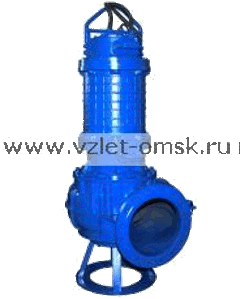 Equipment for pumping heavily contaminated fluids is in fairly high demand. It often helps keep the environment clean. Every sewage pumping station needs to run sufficiently powerful, reliable pumps. The best of them are Russian-made units from the Irtysh series, which are preferable to imported equivalents.
In some cases the job calls for surface-mounted pumping equipment, in others for submersible pumps. The difference is right there in the name. Surface-mounted pumping equipment doesn’t sit inside the body of water or the tank holding the fluid being pumped, and it only comes into contact with it through hoses, unlike submersible pumps — submersible pumps are lowered fully submerged into whatever heavily contaminated fluid, or clean water, they’re pumping.
Each kind of pump equipment has its own strengths and weaknesses. Submersible pumps come out ahead on points. For one thing, surface-mounted pumps tend to take some time to build up to full pumping capacity after switching on, and their output depends on the hose diameter — submersible pumps don’t suffer from that drawback.
Submersible pumps also spare you the significant noise and vibration that surface-mounted pumps produce. Naturally, cooling for pump units submerged in fluid is also well taken care of, courtesy of that same fluid.
The one downside is the need to keep things fully sealed, so fluid can’t reach the live parts of the electric motor or other current-carrying components, power cable cores included. But modern pumps handle this very reliably and without any trouble.
A sewage pumping station is often built around exactly these submersible pump units. Besides the pumps, the main element of a sewage pumping station is the tank that collects the wastewater. It works on the principle that as heavily contaminated fluid or sewage sludge builds up, the pumps switch on and start pumping its contents out.
Switching the pump units on and off is usually fully automated.
A distinctive feature of sewage pumping station pumps is that they use a special type of electric motor — typically a 3-phase squirrel-cage induction motor. It has built-in temperature sensors and is well sealed. If fluid gets into the oil chamber above a set threshold, a moisture sensor trips and the pump unit’s motor shuts off.
Experience shows that Russian sewage pumping stations are fully adapted to wastewater carrying a fair amount of large debris, which gives them a real edge over foreign equivalents. Imported pumps are more delicate and more demanding. That’s why Russians trust their own equipment more.
They trust it more. And practice fully bears that trust out.