The market for demand and consumption of PET strapping in Russia
In this section: 77 articles
- DIY repair of tubeless tyres
- General recommendations for storing and using chains
- Equipment for pumping heavily contaminated fluids
- Packaging board and its properties
- Inflating tyres with inert gases: myths and reality
- SULPHIDE CAPACITY AND OPTICAL BASICITY OF STEELMAKING SLAGS IN STEEL PROCESSING
- What to look out for before fitting a car alarm
- A profiled-sheet rolling mill
- Insulated glass units: the window's key element
- A Group Surprise
- Nanotechnology in everyday life
- The market for demand and consumption of PET strapping in Russia
- Generating electricity at home
- The advantage of using a garage
- ABS, EBD, BAS and other active safety systems
- All types of manual transmission (MT)
- What to give a car owner, and not only a car owner
- Installing a water pressure reducer and why it matters.
- A few tips for an office move
- What types of car paint are there, and why do you need car-care chemicals
Just a few years ago, back in 2005, steel strapping accounted for more than 90% of all packaging material consumption. In those years European countries produced up to 500,000 tonnes of steel packaging strapping annually. But gradually its production levels fell substantially. Experts forecast that by 2015 Europe will produce no more than 200,000 tonnes of steel strapping a year, meaning its output will have dropped by more than 60%.
So why is this happening? The whole point is that steel has been replaced by the more modern, economical and convenient PET strapping.
Packaging strapping made of polyester can successfully replace steel strapping for banding heavy loads. Polyester strapping has a number of advantages over its steel counterparts: not only is its strength no lower than that of steel strapping, it's also more elastic and more chemically resistant.
Polyester packaging strapping:
- holds a high-strength tension that securely holds the load in place, without stretching or loosening;
- absorbs impact well thanks to its elasticity, elongation and strength, letting it absorb impact forces during transport and during loading and unloading;
- is considered the most convenient and safest to use, since it has no sharp edges, so you can't cut yourself on it, and it doesn't scratch the load or damage its corners;
- weighs 6 times less than steel strapping;
- keeps its tension and working condition across a huge temperature range, from -60°C to +90°C.
Thanks to all the advantages listed above, polyester strapping is successfully pushing steel out of many industries.
Demand for PET keeps growing steadily. Consumers have come to appreciate all its advantages, so consumption grows by 30-33% more strapping every year compared with the year before.
Chart 1. Growth in PET strapping consumption by year. (data from the Academy of Industrial Market Studies)
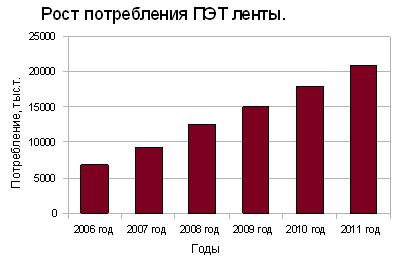
Looking at the chart data, it's easy to see that over the last 5 years consumption of polyester strapping has tripled. Its share in packaging for dust, timber and building materials keeps growing. Brick, board, tongue-and-groove panelling, timber beams, refractory products, plywood, rolled metal, chipboard, paving slabs and much more are now far more convenient to transport once banded with PET strapping. What's more, demand for polyester packaging strapping keeps exceeding supply, though the shortfall in 2009 was around 19%, compared with over 30% just three years earlier. The demand shortfall for PET strapping has been shrinking because capacity at existing PET strapping production equipment is being expanded worldwide. What's more, according to the Academy of Industrial Market Studies, annual growth in new PET strapping production capacity coming online exceeds 10%.
Just 2-3 years ago you couldn't buy domestically produced polyester strapping in Russia — it simply didn't exist. Polyester packaging strapping from global manufacturers such as Signode, Fromm and Cyklop was in high demand. But the price of imported PET strapping was fairly high, so most consumers preferred domestically produced steel packaging strapping. The situation changed radically once domestic manufacturers of polyester strapping appeared. Domestic PET strapping manufacturers charge more affordable prices than their foreign counterparts, and in terms of quality Russian PET strapping is in no way inferior to the European product. So the market for producing polyester packaging strapping is young, but quite promising and growing fast.