All types of manual transmission (MT)
In this section: 77 articles
- DIY repair of tubeless tyres
- General recommendations for storing and using chains
- Equipment for pumping heavily contaminated fluids
- Packaging board and its properties
- Inflating tyres with inert gases: myths and reality
- SULPHIDE CAPACITY AND OPTICAL BASICITY OF STEELMAKING SLAGS IN STEEL PROCESSING
- What to look out for before fitting a car alarm
- A profiled-sheet rolling mill
- Insulated glass units: the window's key element
- A Group Surprise
- Nanotechnology in everyday life
- The market for demand and consumption of PET strapping in Russia
- Generating electricity at home
- The advantage of using a garage
- ABS, EBD, BAS and other active safety systems
- All types of manual transmission (MT)
- What to give a car owner, and not only a car owner
- Installing a water pressure reducer and why it matters.
- A few tips for an office move
- What types of car paint are there, and why do you need car-care chemicals
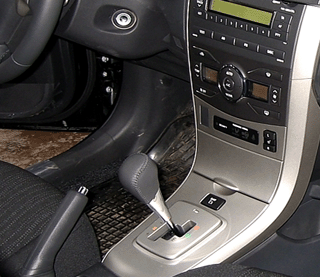 First, a bit about the transmission itself — a gearbox houses gear wheels of various sizes, and it's their interaction that controls the gear changes.
There are three main types of manual transmission — classic, robotised, and robotised MT with two clutches.
A car's classic manual transmission works on a simple principle — the interaction of gear wheels controls the car's wheels. Here's how it happens: the first small gear wheel handles the engine's rotation, then that small gear wheel meshes with a larger one, and the larger one transmits torque directly to the car's wheels. This way, you've reduced speed but increased torque — that's first gear.
If the difference between the gear wheels is small, the boost in torque will be smaller, and the speed, accordingly, will rise — that's a higher gear.
Neutral gear — when gear wheels of equal size interact, neither speed nor torque changes.
As is clear from the above, the indicator of the change in speed and torque when shifting into any given gear is the gear ratio and the transmitted torque.
A robotised manual transmission is a combination of mechanical and electronic control of the gearbox. Given that you can switch fully to manual control, a robotised manual transmission can also work almost like an automatic gearbox. Where a car has this type of transmission, there's no clutch pedal. Despite all its similarity to an automatic, a robotised manual transmission is cheaper and more economical than a standard automatic. This kind of transmission is quite popular, and it's used in their cars by many well-known makers, Skoda for example.
And finally, the third type of MT is the robotised dual-clutch transmission. Two clutches are needed so that one of them handles the odd gears and the other the even ones. The gear-shift process happens very quickly, literally in fractions of a second, which makes this manual transmission convenient to use, and it's rightly considered the most convenient, most dynamic and, at the same time, most economical transmission there is.
In closing, it's worth saying that in terms of dynamics and practicality, any manual transmission will significantly outperform an automatic.