A profiled-sheet rolling mill
In this section: 77 articles
- DIY repair of tubeless tyres
- General recommendations for storing and using chains
- Equipment for pumping heavily contaminated fluids
- Packaging board and its properties
- Inflating tyres with inert gases: myths and reality
- SULPHIDE CAPACITY AND OPTICAL BASICITY OF STEELMAKING SLAGS IN STEEL PROCESSING
- What to look out for before fitting a car alarm
- A profiled-sheet rolling mill
- Insulated glass units: the window's key element
- A Group Surprise
- Nanotechnology in everyday life
- The market for demand and consumption of PET strapping in Russia
- Generating electricity at home
- The advantage of using a garage
- ABS, EBD, BAS and other active safety systems
- All types of manual transmission (MT)
- What to give a car owner, and not only a car owner
- Installing a water pressure reducer and why it matters.
- A few tips for an office move
- What types of car paint are there, and why do you need car-care chemicals
Today, profiled sheet has rightfully carved out a solid niche in the building materials market. Its strong standing comes down to the fact that, during construction, this material can “replace” flooring, walls and ceiling alike, and is often used as a finishing material too. The prospects for using it are huge. Production efficiency is very high and holds undeniable interest as a business project. Setting up production requires a profiled-sheet rolling mill.
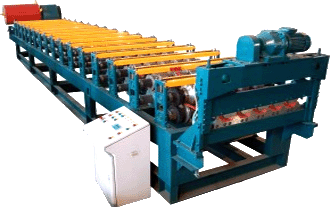 Equipment for producing profiled sheet consists of a roll-forming unit and auxiliary devices. The auxiliary devices include a cantilever uncoiler, guillotine shears and a receiving device. Together they form a production line, at the end of which comes a ready-to-use product. The whole production cycle is automated thanks to a modern control system.
The raw material for profiled-sheet production equipment is thin galvanised coil steel, either painted or coated with polymers that give it excellent decorative and anti-corrosion properties.
The production process itself is simple. The coil steel is fed through a guide device straight onto the rolling mill, where rollers form the required profile, giving the product increased strength.
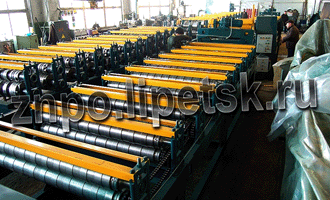 From the rolling mill, the blank moves on to profile-shaped guillotine shears, which trim it to the specified size. The finished product is then carried to the receiving device and stacked.
Equipment for producing profiled sheet is fitted with rolling rolls of various sizes, which determine the profile height. This parameter determines the type of profiled sheet. It can be a wall type, a roofing type or a load-bearing type. Wall profiled sheet has a profile height of about 2 cm, roofing sheet up to 40 cm.
Load-bearing profiled sheet has a taller profile.
Perhaps you need a two-storey profiled-sheet rolling mill? It lets you produce not just various types of profiled sheet, but metal roof tiles at the same time. There are no special requirements for the premises a profiled-sheet rolling mill is installed in.
The production process is notable for producing no harmful emissions or waste. But some small additional mechanization tools, such as a monorail with a chain hoist or an overhead crane, will come in handy.
There's no need to worry about selling the finished product. It's genuinely competitive, highly profitable and in great demand.