Insulated glass units: the window's key element
In this section: 77 articles
- DIY repair of tubeless tyres
- General recommendations for storing and using chains
- Equipment for pumping heavily contaminated fluids
- Packaging board and its properties
- Inflating tyres with inert gases: myths and reality
- SULPHIDE CAPACITY AND OPTICAL BASICITY OF STEELMAKING SLAGS IN STEEL PROCESSING
- What to look out for before fitting a car alarm
- A profiled-sheet rolling mill
- Insulated glass units: the window's key element
- A Group Surprise
- Nanotechnology in everyday life
- The market for demand and consumption of PET strapping in Russia
- Generating electricity at home
- The advantage of using a garage
- ABS, EBD, BAS and other active safety systems
- All types of manual transmission (MT)
- What to give a car owner, and not only a car owner
- Installing a water pressure reducer and why it matters.
- A few tips for an office move
- What types of car paint are there, and why do you need car-care chemicals
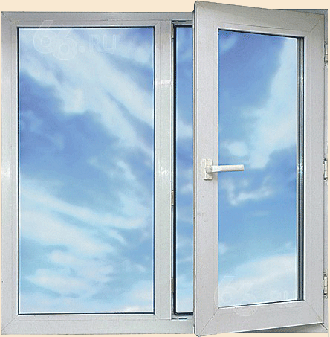 The construction of a wooden window is familiar to everyone. Even now you can describe it in a couple of words. To get a wooden window ready for installation, you need a frame, glass and glazing beads. The glass is fitted in the centre of the frame and is bordered on both sides all around the perimeter by glazing beads. The beads are then nailed to the frame with small nails. That's how the glass is held in place. And there you have your finished wooden window.
You'd think a window made of plastic wouldn't differ all that much in construction from a wooden one. But no. It's not that simple. In reality, the construction of a plastic window is an order of magnitude more complex. Just open up any diagram to see that this product's number of structural elements runs into double digits. But the main element among all of them is the insulated glass unit.
Insulated glass units are the core elements of plastic windows, made up of several panes of glass and spacer bars. The unit's main characteristic is the number of chambers. In our country, single- and double-chamber glass units are the most common — that is, ones whose construction has two and three panes of glass respectively.
The spacer bars, which are also part of the glass unit's construction, sit between the panes. When there are more than two panes — that is, when the glass unit is multi-chambered — the width of the spacer bars needs to vary. If, in a double-chamber unit, the width of the bars (and, accordingly, of the chambers) is the same, you won't get the effect expected from a double-chamber unit.
Today many construction companies fit single-chamber glass units in new buildings. But for our harsh winters that isn't a great solution. So if you've bought a flat in a new building, and a few hundred dollars isn't a major expense for you, we recommend fitting plastic windows built with double-chamber glass units instead.
The space between the panes, in turn, can be filled with a certain inert gas. This is done to boost energy efficiency. That said, this "charge" only lasts around 10 years. And once the gas pumped in at the factory has leaked out, you'll need to repeat the procedure of pumping gas into the glass unit's chamber yourself. But that's not too complicated. Today many companies offer this kind of service.