SULPHIDE CAPACITY AND OPTICAL BASICITY OF STEELMAKING SLAGS IN STEEL PROCESSING
In this section: 77 articles
- DIY repair of tubeless tyres
- General recommendations for storing and using chains
- Equipment for pumping heavily contaminated fluids
- Packaging board and its properties
- Inflating tyres with inert gases: myths and reality
- SULPHIDE CAPACITY AND OPTICAL BASICITY OF STEELMAKING SLAGS IN STEEL PROCESSING
- What to look out for before fitting a car alarm
- A profiled-sheet rolling mill
- Insulated glass units: the window's key element
- A Group Surprise
- Nanotechnology in everyday life
- The market for demand and consumption of PET strapping in Russia
- Generating electricity at home
- The advantage of using a garage
- ABS, EBD, BAS and other active safety systems
- All types of manual transmission (MT)
- What to give a car owner, and not only a car owner
- Installing a water pressure reducer and why it matters.
- A few tips for an office move
- What types of car paint are there, and why do you need car-care chemicals
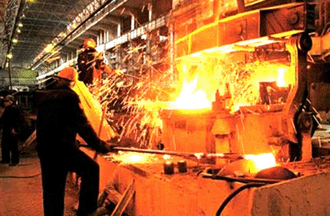 One of the main tasks in secondary steel processing is desulphurisation of the metal, which is only possible given a sufficient amount of slag formation. This creates a need to add lime to the ladle in large quantities. This process comes with extra costs in electrical energy and in the time spent carrying out steel desulphurisation.
You can raise the efficiency of secondary steel processing and cut the time it takes by adding only the minimum necessary amount of lime. This approach is only possible where suitable methods exist for calculating the desulphurising capacity of steelmaking slags of varying composition.
To determine the characteristics of a slag's desulphurising capacity, the concept of sulphide-type capacity Cs is used. This figure can vary within wide limits and depends on how much the slag's composition changes.
A range of approaches has been proposed for accounting for all of a slag's components, but the most commonly used approach relies on the concept of optical basicity.
The equation for determining optical basicity gives a direct relationship with the logarithm of the slag's sulphide capacity. At the same time, many binary systems show a sharp change in capacity in the middle of the integral, and level behaviour at the edges.
For the comparative method, a data set of 400 points was selected, and calculations were carried out:
-
using the original coefficients;
-
by fitting, using the least-squares method, the constants of steel's temperature dependence, while keeping the original element-by-element parameters.
When comparing the optical basicity values for slag components found in the literature with the results obtained through statistical processing, it turned out that the component values match on the main indicators.
Analysis of the results shows that in the ranges of high slag sulphide capacities, the calculations give somewhat inflated values compared with the actual figure. In the other case, the formula-based calculation gives a more faithful description of the actual data presented.
To sum up, the calculations carried out in this work make it possible to identify the preferred equations for calculating the dependence of a slag's sulphide capacity on its composition.
The research carried out will allow for a more precise choice of slag composition and lime consumption in order to achieve the planned degree of steel desulphurisation.
A.I. Kuzmin (MChM-07vm)