Automatic transmission: pros and cons
In this section: 77 articles
- DIY repair of tubeless tyres
- General recommendations for storing and using chains
- Equipment for pumping heavily contaminated fluids
- Packaging board and its properties
- Inflating tyres with inert gases: myths and reality
- SULPHIDE CAPACITY AND OPTICAL BASICITY OF STEELMAKING SLAGS IN STEEL PROCESSING
- What to look out for before fitting a car alarm
- A profiled-sheet rolling mill
- Insulated glass units: the window's key element
- A Group Surprise
- Nanotechnology in everyday life
- The market for demand and consumption of PET strapping in Russia
- Generating electricity at home
- The advantage of using a garage
- ABS, EBD, BAS and other active safety systems
- All types of manual transmission (MT)
- What to give a car owner, and not only a car owner
- Installing a water pressure reducer and why it matters.
- A few tips for an office move
- What types of car paint are there, and why do you need car-care chemicals
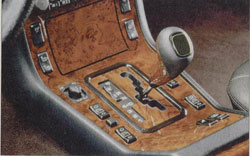 An automatic transmission is a car gearbox that, unlike a manual one, shifts gears automatically and, most often, is also built differently on the mechanical side.
An automatic transmission consists of a torque converter, planetary gearsets, friction and one-way clutches, and connecting shafts and drums. Sometimes a brake band is also used, which slows down one of the drums inside the gearbox housing during a shift. On cars built in recent years, such as Honda, Ford and the Mini Cooper S, an automatic transmission is part of the full equipment package.
A big advantage of an automatic transmission is that there's one less pedal. For many drivers this is an important detail when choosing a trim level. Using an automatic also provides good operating conditions for both the engine and the running gear. This gentle mode of operation is made possible by the torque converter. Cars fitted with an automatic have better traction than cars running a manual. Automatic transmissions have become so widespread that even BMW motorcycles are now offered with one.
But a real downside of an automatic transmission is that cars fitted with it use more fuel than cars equipped with a manual. Though this matters less than it used to, since some modern transmissions, in certain driving modes, can achieve good efficiency thanks to smoother engine speeds and intelligent mode control. On top of that, an automatic transmission doesn't give the driver as much control over the car as a manual does. It's no accident that many concept cars are fitted with a manual, which lets the driver "adapt" the car to themselves rather than the other way around, as often happens with a car equipped with an automatic. What's more, the efficiency of an automatic transmission is considerably lower than that of a manual. It's also worth noting that, all else being equal (engine power, vehicle weight), a car fitted with an automatic will fall behind one with a manual.
We recommend reading further: