Your own car business: looking for wholesale suppliers
In this section: 77 articles
- DIY repair of tubeless tyres
- General recommendations for storing and using chains
- Equipment for pumping heavily contaminated fluids
- Packaging board and its properties
- Inflating tyres with inert gases: myths and reality
- SULPHIDE CAPACITY AND OPTICAL BASICITY OF STEELMAKING SLAGS IN STEEL PROCESSING
- What to look out for before fitting a car alarm
- A profiled-sheet rolling mill
- Insulated glass units: the window's key element
- A Group Surprise
- Nanotechnology in everyday life
- The market for demand and consumption of PET strapping in Russia
- Generating electricity at home
- The advantage of using a garage
- ABS, EBD, BAS and other active safety systems
- All types of manual transmission (MT)
- What to give a car owner, and not only a car owner
- Installing a water pressure reducer and why it matters.
- A few tips for an office move
- What types of car paint are there, and why do you need car-care chemicals
If you're on this site, you love cars, and if you love cars, then at least somewhere deep down you'd like to build a business around them. And that's only natural — everyone wants to do what interests them and get paid well for it. So why not give it a go, especially now that the state has significantly simplified company registration, licensing and tax payment, and lowered the tax rates themselves on top of that.
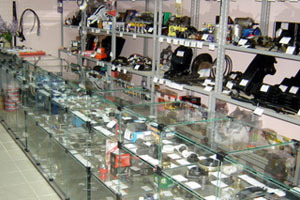 In this article I want to talk about exactly how to go about building your own car business. Let's skip over registering as a sole proprietor or a legal entity (your choice), buying or renting premises for a workshop, and finding clients. Plenty has already been written on all of that by other authors, far more authoritative than your humble servant. Today I want to talk about another, no less (if not more) important part of the car business — suppliers, and specifically how to find good ones. Because whether you run a service station, a tyre shop, or even a small window-tinting outfit, you'll still need to buy something in bulk, be it parts, tinting film, paint, and so on.
To find a good supplier, you need a clear picture of the price-to-quality ratio that works for you, and only then start looking for a supplier who matches those parameters. Let me explain with car parts as an example. Say you own a small shop selling parts for Toyota, Nissan and other Japanese makes, and you want to find a wholesale supplier for those very parts. You're aiming for mid-range quality, roughly the level where customers are satisfied and you're not overpaying for a brand name. In this case, a supplier with its own parts plant suits us best — that way we're ordering straight from the manufacturer, and we win big on price. Thanks to the internet, we now have a unique opportunity to source supplies from any plant across the Eurasian continent (by rail), and it would be a shame not to use it. Go online, type your query into your favourite search engine, and hundreds of sites will offer their wholesale parts services. First you need to filter out the middlemen and keep only the manufacturers. Then look at the price-to-quality ratio and make your final choice based on that.
I'd pay attention to Chinese manufacturers — their quality, especially at companies based in the Hong Kong and Pudong free economic zones, has improved noticeably since the days when calling something “Chinese-made” was an insult to its owner. These days, Chinese factories turn out perfectly decent products fit for the end consumer, and the price hasn't changed much in recent years either. Don't think, though, that I'm praising Chinese industry across the board — there's still plenty of counterfeit product out there, but you're unlikely to pick as your supplier some “semi-artisanal” plant where quality is more than made up for by sheer output and a price that trends toward zero.
Once you've chosen a supplier you consider worthy, you simply need to find their contacts and talk to them through whatever communication channel is available, be it Skype, ICQ, e-mail or a plain phone call. The manager at the company you've chosen will explain everything you want to know, and incidentally, that manager and their manner of speaking can also tell you a lot about how solid the company that hired them really is.
That was a short primer on wholesale purchasing — I hope it's been useful to you. Good luck with your business!