Types of car fridges
In this section: 77 articles
- DIY repair of tubeless tyres
- General recommendations for storing and using chains
- Equipment for pumping heavily contaminated fluids
- Packaging board and its properties
- Inflating tyres with inert gases: myths and reality
- SULPHIDE CAPACITY AND OPTICAL BASICITY OF STEELMAKING SLAGS IN STEEL PROCESSING
- What to look out for before fitting a car alarm
- A profiled-sheet rolling mill
- Insulated glass units: the window's key element
- A Group Surprise
- Nanotechnology in everyday life
- The market for demand and consumption of PET strapping in Russia
- Generating electricity at home
- The advantage of using a garage
- ABS, EBD, BAS and other active safety systems
- All types of manual transmission (MT)
- What to give a car owner, and not only a car owner
- Installing a water pressure reducer and why it matters.
- A few tips for an office move
- What types of car paint are there, and why do you need car-care chemicals
A car fridge is a special mini-fridge built for tough road conditions. This article covers actual fridges, ones that chill food. Cooler bags and isothermal containers are also very handy on the road and popular with fans of getting out into nature, but strictly speaking they aren't fridges, since all they can do is hold in cold, not generate it.
Car fridges are designed on the basis that they must:
- run off the car's electrical system (12 V or 24 V DC);
- be tough enough to withstand shaking and knocks;
- be sized to fit in the boot or cabin of a car.
A car fridge can be thermoelectric, compressor-driven, or absorption-type.
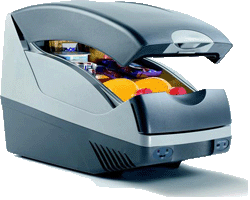 Thermoelectric fridges are the smallest-capacity type, at 0.5-50 litres. Absorption fridges come in a capacity range of 24-140 litres, while compressor fridges are limited only by how much space the car offers — as a rule, compressor fridges range from 18 to 220 litres. All three types of car fridge are on the market, though compressor car fridges hold a much smaller share than thermoelectric ones. That's because a fridge compressor requires particular installation conditions, and on top of that, if the unit's seal is broken, the refrigerant, which is toxic to humans, leaks out immediately.
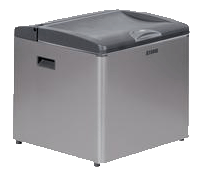 Comparing car fridges by efficiency, the compressor fridge scores best, the absorption type comes second, and the thermoelectric type comes third. And the larger the fridge, the more noticeable this difference in power consumption becomes.
Mini-fridges show roughly the same ranking for cooling speed. Compressor fridges cool fastest, thermoelectric ones slowest. That's why manufacturers recommend putting pre-chilled food into a thermoelectric car fridge, and cooling the compartment itself with ice packs. The same advice applies to owners of absorption car fridges too, even though they still cool faster than thermoelectric ones.
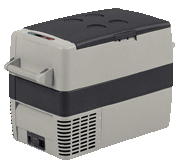 Another area where the compressor fridge clearly beats the other types is the lowest temperature it can reach. Compressor fridges or freezer compartments hold a temperature range of +4 to -18 degrees Celsius without any trouble, whereas only rare models of thermoelectric and absorption fridges cool below +3 degrees (though such freezer-type car fridge models do exist). What's more, a compressor fridge's ability to cool or freeze doesn't depend on the ambient temperature, while thermoelectric and absorption fridges, as a rule, only cool 18-30 degrees below the ambient temperature.
An absorption car fridge can run without electricity (off a gas cylinder), and this way is actually more economical: a single five-litre cylinder is enough for 230 hours of fridge operation. This capability is the main advantage of absorption electric/gas car fridges. Unfortunately, the cooling unit of absorption fridges, just like the compressor, is quite sensitive to how much the car is tilted and stops working at a tilt of more than 30 degrees.
A thermoelectric car fridge doesn't have this drawback. Most thermoelectric fridge models work lying flat, standing up, or even on their side. Like the absorption fridge, a thermoelectric mini-fridge is an environmentally clean device with no harmful refrigerant. The main advantage of thermoelectric fridges is their ability to switch into heating mode. This kind of electrical appliance is very handy on a long trip, when, say, lunch needs to be kept cool first and then warmed up later.
And finally, the last factor: price. Thermoelectric car fridges are the cheapest, and compressor fridges the most expensive.