Airbrushing as a form of self-expression
In this section: 77 articles
- DIY repair of tubeless tyres
- General recommendations for storing and using chains
- Equipment for pumping heavily contaminated fluids
- Packaging board and its properties
- Inflating tyres with inert gases: myths and reality
- SULPHIDE CAPACITY AND OPTICAL BASICITY OF STEELMAKING SLAGS IN STEEL PROCESSING
- What to look out for before fitting a car alarm
- A profiled-sheet rolling mill
- Insulated glass units: the window's key element
- A Group Surprise
- Nanotechnology in everyday life
- The market for demand and consumption of PET strapping in Russia
- Generating electricity at home
- The advantage of using a garage
- ABS, EBD, BAS and other active safety systems
- All types of manual transmission (MT)
- What to give a car owner, and not only a car owner
- Installing a water pressure reducer and why it matters.
- A few tips for an office move
- What types of car paint are there, and why do you need car-care chemicals
A huge metropolis levels everyone and crushes them under its sheer scale and mass. Pulling out onto the streets of Moscow in the morning, or any other big city for that matter, we join a stream of cars racing along at full speed, barely distinguishable from one another. Depersonalisation is the curse of the modern city. Is there a way out?
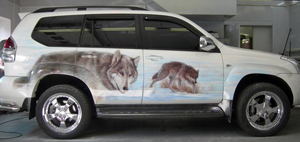 If you're someone genuinely ready to push back against the levelling pressure of the big city, one striking way to show the people around you who you are is airbrushing. These days, airbrushing means applying an image to a car's surface using a tool purpose-built for the job — a compressed-air spray gun known as an airbrush. A handful of skilfully executed passes, and the sun-bright polish of your car's body is topped off with a vivid image that becomes your calling card, the thing that instantly identifies you and your car in the endless urban stone jungle.
It's hard to believe, but the airbrush was invented in America more than 140 years ago. And the American answer to our own Kulibin somehow managed to cobble one together out of a Singer sewing-machine needle, soldering tubes and a screwdriver. In principle, the airbrush works much like a spray gun, also relying on compressed air, which draws in the paint as it blows and then sprays it out. But modern airbrushes are far more advanced tools than simple spray guns. They let you not just spray paint but control exactly how much of it flows, giving true masters of the craft the ability to lay down not just a general background but the finest of lines, producing images on metal with a striking sharpness, not unlike a photo shot on a DSLR.
Racing cars were the first to carry images like these. In the 1960s, during the heyday of countercultural movements in the US, every self-respecting hippie decorated their car's body with some kind of peace-loving biblical scene. Airbrushing reached Russia along with the start of the economic reforms. One fine day, cars started appearing on the streets of Moscow and St. Petersburg with all sorts of ominous figures painted across their "bodies": eagles, torches, horses, sponsor logos, and so on. At first the artists applied the images with a brush, and then came the era of spray guns, which continues to this day.
To have a bright, memorable image airbrushed onto your car, you only need three things: the desire itself, an artist, and, of course, money. The theme, style and placement of the future image can be worked out together with the artist. They'll also develop the sketch for the future image and then, using the well-known Adobe Photoshop or something similar, apply the drawing onto a photo of your "steed," which you'll need to provide.
Once the sketch is approved, it's time for the true masters of the trade — the car artists. They prepare the body panels for the image by matting down the top layer of clearcoat with a special abrasive paste, so the paint will later go on smoothly. If the body has any scratches, dents or chips, at least a light body repair will need to be done first. Either way, such defects have to be fixed before the future masterpiece takes shape.
Once the body is ready to work on, special automotive paints are used to apply the images. Some are created using stencils, others straight "freehand." When the car artists finish their work, the body surface is clear-coated and polished. Everything ready? Then hop in and drive!