BMW suspension repair
In this section: 77 articles
- DIY repair of tubeless tyres
- General recommendations for storing and using chains
- Equipment for pumping heavily contaminated fluids
- Packaging board and its properties
- Inflating tyres with inert gases: myths and reality
- SULPHIDE CAPACITY AND OPTICAL BASICITY OF STEELMAKING SLAGS IN STEEL PROCESSING
- What to look out for before fitting a car alarm
- A profiled-sheet rolling mill
- Insulated glass units: the window's key element
- A Group Surprise
- Nanotechnology in everyday life
- The market for demand and consumption of PET strapping in Russia
- Generating electricity at home
- The advantage of using a garage
- ABS, EBD, BAS and other active safety systems
- All types of manual transmission (MT)
- What to give a car owner, and not only a car owner
- Installing a water pressure reducer and why it matters.
- A few tips for an office move
- What types of car paint are there, and why do you need car-care chemicals
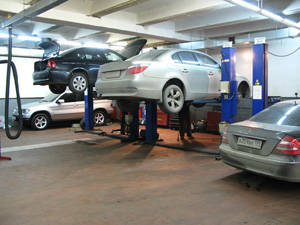 The suspension on a BMW is known for consistent quality and a high degree of reliability. Even so, components such as ball joints, control arm links and stabiliser mounts, upper mounts with their bearings, and the shock absorbers, which take constant mechanical loads from road irregularities, wear intensively and quite often fail earlier than they should. The main signs of a faulty BMW suspension show up as unusual behaviour of the car on the road. The car loses stability, and wear on the front or rear axle can be noticeable on rough roads and in corners. Extraneous noises may also be heard when crossing tram rails or when a wheel drops into a pothole. A longer braking distance and body shake are likewise signs of a suspension fault and reason to head straight to a BMW repair shop.
Diagnosing, servicing and repairing a BMW suspension calls for modern equipment, specialised tools and highly qualified technicians. The main diagnostic tool is a rig fitted with special computer equipment. Suspension diagnostics involves assessing the condition of the shock absorbers, springs, strut bearings and mounts. The ball joints and tie rod ends are also checked, for freedom from play. Ball joints serve both to turn the wheels and to keep the car stable on rough roads. A faulty ball joint shows up as a knock from the front suspension when the wheels hit potholes in the road. Over time, a failed ball joint can lead to loss of control of the car. When the tie rod ends are faulty, turning the wheel is accompanied by a knock, or free play appears in the steering shaft. In more neglected cases the car loses steering precision and wanders while driving. On top of that, the bushings, which carry the bulk of the loads coming from the suspension, are also assessed. A fault in these parts usually shows up as tyre wear along the sides. The car may also pull from side to side.
Shock absorber repair is usually done first, then the bushings are replaced, followed by replacement and adjustment of the strut bearings. BMW suspension repair often stops right there. But driving safety depends directly on every single part of the car being in good order, without exception, so it's worth repairing the whole suspension set at once. In this respect, repairing a BMW E46 is no different from repairing any other BMW model.